The Early Outlook For Crystal Palace In 2018/19

Written by Guest Blogger

We're into mid June, so time to check in and see how things are going at Palace this summer as they prepare for a record sixth consectuvei season in the top flight.

All things considered, this is not the summer for Premier League prognosticators. The World Cup is underway, and it’s been a thrilling one so far. While this won’t stop domestic diehards from keeping their eyes on summer transfers, early projections, and general news, it certainly lends a different feel to the offseason.

That said, the Premier League will be back before we know it, and Crystal Palace will be hoping to improve upon a thoroughly satisfying 2017/18 campaign.

The Goal Moving Forward

Some went into the 2017/18 season with the simple goal of avoiding relegation. That, in some ways, should always be the goal, but we know now that this iteration of Crystal Palace is too good for such a morbid goal.

A 7th place finish in the EPL was a very good finish, and while it’s a tall order, it now feels realistic to hope for a slight improvement on that position - or at least to retain a spot in the top ten. The Eagles will start the season with one of the easiest schedules, which sets things up to be tricky later on, but also provides an opportunity to gather momentum.

Summer Moves & Targets

The summer transfer window will remain open a while longer, so the roster at the time of this writing may well be different from what we end up with in August. that said, Crystal Palace has been active to this point. Signing Vicente Guaita for three years to take over in goal was perhaps the biggest move to date.

However, the club will also get midfielder Jordon Mutch back from a loan to the MLS. Meanwhile, Erdal Rakip will be back to Benfica as his own loan expires, Damien Delaney is en route to Cork City, and a few other players remain unsigned by the Eagles at this point (most notably 35-year-old keeper Diego Cavalieri).

There are some spots yet to fill, however, and Crystal Palace is known to be in the hunt for West Ham winger Michail Antonio and Norwich midfielder Ben Godfrey, among others.

Embed from Getty Images

Waiting On The Oddsmakers

It’s a little bit early for anything but the most basic of Premier League odds, so there’s really no point in looking up predictions and statistical projections just yet. However, online oddsmakers are doing as much business as ever, and new casino and betting platforms are popping up with fresh content and up-to-date features on a regular basis.

So, as we move toward the autumn, and particularly after the World Cup, start to keep an eye out for EPL odds. It’ll be very interesting to see if the Eagles are expected to stay in the upper third of the league or if the knowledgeable folks behind the odds wind up predicting a little bit of slippage.

An Early Prediction


Predicting anything better than the 2018/19 finish seems blindly optimistic. However, it also seems clear that Roy Hodgson is establishing a new tone this team, and a top-10 finish for a second year running looks entirely likely

So the prediction here, conservative as it may be, is that the Eagles will wind up somewhere in the 7-10 range once more.


John Bostock 10 years later: Should Crystal Palace fans still be annoyed?

Written by Dan Cooper


Let's just admit it, we all love a pantomime villain. At Palace we've had our fair share over the years – Iain Dowie, Kevin Miller and Steve Bruce are just a few of the misguided souls who've experienced the full power of both barrels from the Holmesdale.

But perhaps the biggest of them all in Eagles supporters' eyes was just a teenager when he forced South London's finest to turn on him; John Bostock. Now, 10 years later, the midfielder is back at Selhurst for an interview with Palace TV and fans are still spitting feathers online about him.

There was of course a time when things seemed very different. When a 15-year-old Bostock made his debut for Palace back at the start of 2008, it all seemed too good to be true. Here was a kid coveted by Europe's finest, bossing a Championship midfield for 20 minutes as if it was the easiest thing in the world.

And just when it seemed like it couldn't get any better, suddenly we find out that he's a season ticket holding Palace fanatic – a footballing prodigy whose sole aspiration was to captain the Palace to future glory. Could it all be true? Well, yes actually, according to the man – sorry, boy – himself. In a gushing interview with SE25 magazine Bostock spoke extensively of his love of Palace, of how he wouldn't want to be anywhere else and of how, as a season ticket holder since the age of five, he had always preferred to ignore the advances of of the big boys.

After that...well, you all know the story. As news filtered through of his abdication to Spurs, the message boards were soon bursting at the seams with anti-Bostock sentiment, much of which wasn't concerned with holding back. But as the c-bombs and wishes of career ending injuries endlessly rained down, it was hard not to feel a little bit uncomfortable with the sheer volume of undiluted vitriol aimed at a bloke who was, to all intents and purposes, barely out of nappies.

Bostock's proclamations of love for Palace – made mere months before his acrimonious departure – were undoubtedly ill-advised, but many fans seem to forget that, at 15 years of age, he was still very much a child. Can anyone reading this article really claim that they never made an error of judgement at that age? And yes, his retrospective comments regarding his 'stagnation' at Palace and the mismatch between our footballing philosophy and his future development were particularly tough to stomach.

Put simply, Bostock isn't without his foibles; publicly lambasted by Harry Redknapp for his poor attitude after a disappointing stint on loan at Brentford last year, he certainly seems to lean a little too far towards the arrogant end of self-confidence at times. Soon after his departure, rumours regarding his apparent unpopularity on the training ground began to circulate; when he joined Hull, their players reportedly took to calling him 'Boss-man', a nod to his 'me, me, me!' tendencies which allegedly shine through both on and off the pitch.

But rather than wasting time still spitting bile at a man who's career has not gone anywhere near as well as it should have, as football fans we should surely be aiming the vitriol squarely at a the real villains, of whom – as if we needed any reminding - there are many. Chief among these are the men who continue to preside over a system in this country that allows promising young kids from the lower leagues to be cherry picked by the Premier League seemingly at will, with smaller clubs being strong armed into accepting risible sums of money to 'compensate' for years of player development.

Embed from Getty Images

Back in 2010, two years after Bostock left Palace, an article by Steve Parish in the Evening Standard discussed ongoing plans for a fixed compensation package which, if implemented, would effectively allow Premier League teams to pillage lower league academies whilst simultaneously leaving the affected clubs without any room for compensation negotiation.

That was the much malgined FFP is still a sore point for many clubs. And against multiple major tournament disasters from England, the flagrant stockpiling of English youngsters by the Premier League is still all the more depressing.

Could anyone claim that John Bostock's career has developed to any significant degree? Bostock's apparent betrayal of his boyhood club may well stick in the throat, but I find it hard to conjure up that much disdain for a misguided kid who was woefully ill-advised by a whole host of people who are old enough to know much, much better.

Let's not forget that some of those closest to him can have the very dubious honour of being included within this group. Indeed, in many ways my overriding emotion is one of pity – like many others before him, Bostock has been led wildly astray by the 'instant success, get-rich-quick' fallacy pedalled by many Premier League clubs as a core part of their acquisition strategy.

As long as the vultures are allowed to infiltrate other clubs' academies without so much of a sniff of regulation, then we can all expect to see many more John Bostocks added to the scrapheap of young English talent over the next few years.

Luckily for John, all is certainly not lost. Blessed with bags of talent and an almost disconcerting level of self belief, John Bostock is a player who still has a very real chance of carving out a hugely successful career at the highest level. That said, the success of his career from here on in should be of little interest to Palace fans; Bostock may be gone, but the seemingly never ending conveyor belt of talent being churned out of our academy should give every Palace fan cause for great optimism. Still stuck in the bottom three and with injuries mounting up, this is a team that needs the fans focussed on getting behind them.

So rather than wasting time on some Hull City player, why not raise the roof for a crop of local lads who really know what it is to wear the red and blue with pride. Apart from anything else, I've got a sneaky suspicion that it'll show Bostock exactly what he's been missing these last two years.


Thank You, Damien Delaney - Goodbye to a proper Crystal Palace legend

Written by Robert Sutherland

Damien Delaney has signed for Cork City in the League of Ireland, returning to where he first started as a kid. Here's Robert remembering the defender's role at Palace. 

Damo Villa
 
Crystal Palace love unlikely heroes. Bring us your unfashionable, unwanted masses and if they apply themselves, we'll adopt them as our own and give them the backing they wouldn't have had elsewhere. Damien Delaney is such a player. Such a hero. 
 
When Delaney arrived at Palace's training ground following an invitation to train with the club by then-manager Dougie Freedman, few would have expected the Irish centre-back to play a significant role in the clubs run to the Premier League and its establishment in the competition in the seasons that followed.
 
Delaney had, by his own admission, hit rock bottom following his release by Ipswich Town. He had considered retirement entirely -- an interest in triathlons offered a potential escape from what had turned into a disappointing career trajectory for the player. He was ready to hang up his boots but in Palace, he found sanctuary. 
 
Palace weren't looking at Delaney's situation as a charitable cause. Freedman needed an experienced centre-back to help shore up the club's back line. With Delaney apprehensive to commit, Freedman initially invited him to train with the club and ultimately offered him a short-term contract. From small beginnings come big achievements, and this was one for the club.
 
Delaney's introduction to the team against Sheffield Wednesday on the 1st of September 2012 saw Palace collect their first win of the season -- the club went on an unbeaten run of 14 games with Delaney present in all of them. He went on to play almost every game for the rest of that season, making a total of 48 appearances for the club. 
 
 
The aftermath of the final game of the season, against Watford in the play-off final, saw Delaney at his most emotional. Walking up the steps to collect his winner's medal, Delaney fell to the ground in tears. A player on the brink of retirement, not through age or injury but through exasperation at his struggle to make it, helped to win Palace an unlikely promotion.
 
His experience, to have gone from almost nothing to having something so grand to celebrate, reflected the experience Palace had as a club and as a support. Like Delaney, Palace went from nothing to something. The image of Delaney celebrating the win with his teammates as he's drenched in champagne is just as iconic. It was a celebration in its purest form. 
 
Football can be brutal though, and the assumption was that with the club promoted, Delaney would be one of the players sidelined by supposedly better players coming in. It was assumed that the defender had done his job by getting Palace promoted -- few really expected him to step up to the Premier League.
 
But that character, which saw him adapt so well to his teammates, helped him to find his way in the top division, too. Delaney made that centre-back role his, initially under Ian Holloway, then under caretaker boss Keith Millen, and then under Tony Pulis. He was very nearly an ever-present in Palace's first team, forming a great defensive partnership with Danny Gabbidon and then Scott Dann. 
 
Delaney
 
It's testament to his character that, despite the ever-changing fluidity of Premier League football, Delaney was a crucial player in the first three seasons of Premier League football. While his age caught up with him over time, he played a significant part under Pulis, Neil Warnock and Alan Pardew. He was a defensive leader and helped to lead the side through the many challenges they faced.
 
Plenty of opponents struggled with Delaney's physical approach -- none more so than Diego Costa. That game against Chelsea, under Pardew's remarkable run, saw the Irishman play at his formidable best; despite antagonism, aggression and cynicism, Costa just couldn't get the better of his opponent. It was a match-winning performance that summed up his qualities. 
 
It's clear that Delaney was an emotional person in the dressing room. On occasion, that emotion would show on the pitch too. There were times where he interacted with supporters when he perhaps shouldn't have. In that fateful game against Sunderland which Palace went on to lose 4-1, Delaney gestured for fans to calm down.
That tension was obviously unbearable for the defender, but rather than calm the situation it worsened it. By half-time, the supporter who ran on the pitch to confront the players happened upon Delaney, as he was the first to jog towards the changing rooms. He would have been within his rights to react with aggression, but he didn't. He understood the frustration -- he often spoke of it in the aftermath of defeats. But his attitude -- of working hard to make it right, always rung true. 
 
He wasn't a world class centre-back. But he was a supremely functional, uncompromising defender. The kind that many strikers would hate to play against and the kind that football fans would love to watch. 
 
His experience at Palace, and throughout his career, should serve as an example to others. That even at the age of 31 it's not too late to play a major role in a club's history. That when you're at your most desperate, there is always another way. Delaney is proof that hard work and dedication can make you a winner.
 
He'll always be a winner at Selhurst Park. A hero whose contribution will never be taken for granted. 
 
Thank you, Damo. 

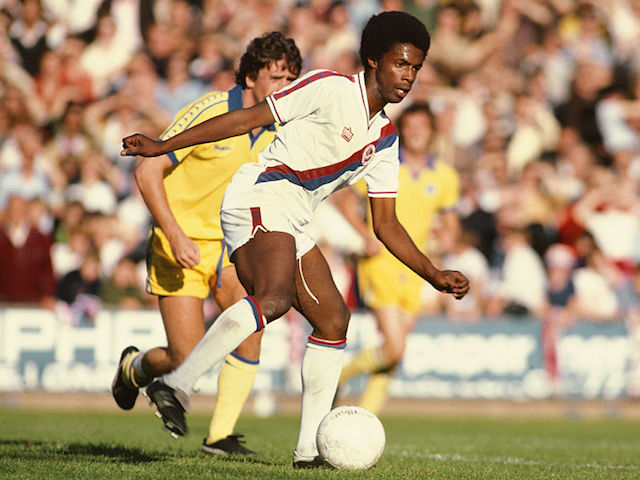
Remembering Vince Hilaire - one of the most important players in Palace's history

Written by Bert Saltoun

The new PUMA sash away kit launch brought back memories of Vince Hilaire in that last 70s sash. Here's why he is one of the most important player in Palace's history. 

Embed from Getty Images

South London in the 70s and early 80s was a pretty grim place to be a young black man. The fascist National Front, with its headquarters in Pawsons Road, seemed to have a demonstration somewhere on an almost weekly basis and enjoyed the kind of police protection that a victim of a racial hate crime could only dream of.

Young white men, disaffected by long running industrial disputes and the spectre of Thatcherism on the horizon, provided an easy recruitment pool for extremists. Lampposts and walls everywhere were adorned with the NF logo and racist views were expressed freely, often on mainstream television shows.

However, such hateful ignorance conflicted the minds of the inhabitants of one pocket of the area surrounding Thornton Heath and Croydon, and that was mainly down to one man.

Born in Forest Gate, East London, Vince Hilaire joined Palace as a junior and made an almost immediate impact in our all conquering youth team that was carefully nurtured by Malcolm Allison and Ernie Walley and included future stars such as Kenny Sansom and Peter Nicholas, and it wasn't long before Terry Venables handed him a debut towards the end of the 1976/77 season at the tender age of 17.

Well meaning but, by today's standards, wholly inappropriate reports in the matchday programme invariably referred to our "exciting coloured forward" and the fans on the Selhurst terraces soon took Vince to their hearts, despite the racist backdrop that we lived under at the time, that was more often than not encouraged by the gutter press.

1977/78 saw Vince become a regular starter in the first team whilst also helping the juniors win the FA youth cup and the following season he was voted Supporters Player of the Year.

Well built, super fast and with some amazing skill on the ball, Vince provided the ammunition for the likes of Dave Swindlehurst and Ian Walsh to fire us to the top flight at the turn of the decade and soon picked up England U21 caps. A debut for the full England side looked to be on the horizon, but sadly fate had other ideas.

Chairman Ray Bloye (one of the most crooked men ever to take control of a football club), decided that he'd had enough of his toy and, after selling off a large chunk of the land that was the property of the football club (and lining his own pockets in the process) he sounded out Blackburn's promising young manager Howard Kendall to take over from Terry Venables.

Venables eventually learned about this and was straight off to QPR, taking much of the squad with him. A conveyor belt of below par managers followed, including a disasterous return for Malcolm Allison, and over the next few years the club bedded in to a slow and painful decline.

It was around this time that Vince's career should've taken off. The likes of Viv Anderson and Laurie Cunningham had already opened the door for quality black players to represent their country and Vince really should have joined them as he was as good if not better than any winger in the England squad at the time.

But it wasn't to be. The upheaval around the club along with the offloading of the likes of Peter Nicholas, Kenny Sansom and Dave Swindlehurst put the club into a rut that it took the best part of a decade to recover from. Vince loyally soldiered on for Palace for another few seasons, and was often the only highlight of going to watch Palace during the darkest days of Alan Mullery's tenure.

Once Mullery left Vince decided he'd had enough. Even the appointment of one of England's best wingers of recent times as the new Palace manager couldn't persuade him to stay, despite Steve Coppell pleading with him and promising to make him an even better player, and he left for Luton in the close season.

For reasons that have never been clear, Vince's spell in Luton lasted only a couple of months before he went on to join his close friend Billy Gilbert at Portsmouth where he had a long and successful career and he eventually returned to Selhurst Park as an opposition player at the end of the 1985/86 season where he was duly sent off for throwing Andy Gray into the Main Stand.

The following season Pompey were promoted to the top flight and once again Vince was able to show off his mesmerising skills at the highest level, albeit for only a single season as Pompey were relegated at the first attempt.

Embed from Getty Images

Later on as his Pompey contract ran down Vince was linked with a return to Selhurst Park and Steve Coppell confirmed his interest in bringing him back, but Leeds offered more money and he spent a couple of seasons there before winding his career down with Stoke and Exeter. A brief spell as joint manager of Waterlooville with Billy Gilbert followed, and Vince is now to be found doing matchday hospitality at Fratton Park.

It's very easy to look back upon our childhood heroes with rose tinted glasses. As children our brains are still in development and we gauge how good a footballer is by how exciting we find that player. Vince was nothing if he wasn't exciting. One of the most naturally skilled players ever to grace the Selhurst turf, he also had an aggressive streak which came to the fore most when he pushed the referee over during a game against Tottenham.

Would he have made it in the modern game? I like to think so. In fact if there's a modern day player who we could most compare to Vince, that player would be his successor on the flanks, Wilfried Zaha.

Training methods and tactics back in the 70s and 80s were rather primative - who's to say that if Vince had been given the same first class coaching as Wilf has, that he wouldn't be a star in the modern day game? I guess we'll never know.

One thing's for certain, though. Vince Hilaire is one of the most naturally gifted footballers I've ever seen and, along with my late father, he is the reason I became such an avid Palace fan in the first place.


Palace Launch New Kits with a Fresh Touch of the Classic

Written by Robert Sutherland

Palace launched their new kits, and we're delighted with them. 

Stripes 2

Stripes. You can only do so much with them. 

That's a statement that Steve Parish probably regrets somewhat. It came as Crystal Palace unveiled the kit that is now synonymous with Alan Pardew's managerial decline and Sam Allardyce's rescue act - a red shirt with a thick blue block (you can't call it a stripe) down the middle.

The idea, supposedly, was that if the players lined up alongisde each other they'd create one big red and blue striped mass. The result didn't match that. It was as if Palace wanted to be a red and blue Ajax. But stripes are Palace's colours. Not hoops, not blocks, not single colours. Red and blue stripes. 

Macron made amends with this season's kit, a traditional, simple red and blue shirt that, from the number of them worn in the stands on a matchday, seemed to be popular.

It was a fitting end to what has actually been a very good deal with the Italian kit manufacturer - Palace's kits have, on the whole, been excellent. The initial fears about quality were misplaced, and the training gear (especially this season) has been outstanding.

Wednesday's unveiling of Puma's new strips has been met with unanimous agreement - the designs are exactly what was wanted, with a touch of uniqueness and a classic verve too. 

While the headline design element is the striped fade on the home shirt, providing a gradient that goes from red to blue, the away kit is the one that drew the most attention among supporters. It's been a while since Palace have had a sash shirt, and the classic design is one which supporters love dearly.


Seeing the meeting of legends new and old, as Wilfried Zaha met with Vince Hillaire in the launch video (below), gave the kit launch a sense of continuity.

A passing of the torch. Zaha is this generation's Hillaire - direct, skillful, exciting - iconic. Zaha in a sash kit just seems right. 

Both shirts should be hugely popular. The colours are right. The designs are right. They're unique and interesting.  The kits are expected to go on sale in early July, and like the Macron kits before them are available in both skin-tight player fit and a more casual regular fit. 

We're looking forward to seeing how they look on the pitch at home and away. 

Roy Hodgson Hasn't Just Saved Crystal Palace's Season - He Has Restored the Team's Spirit

Written by Robert Sutherland

Roy Hodgson has brought character back to a side that lacked it. Here's Robert Sutherland with a look at what has changed. 

Team Huddle

Fighting adversity collectively builds a unitary strength among teams, bringing friendships and camaraderie to the forefront. The Crystal Palace of Roy Hodgson are a team - a unit ready to go to battle - freed from the shackles of individualism and personal glory.

It wasn't always like this. When you rid a team of leaders, you lose that glue. That cohesion which you work so hard to concoct can be so easily dissolved by removing those binding elements. Naivety can lead you to believe that the cohesive quality of a team is just a byproduct of tactics - but it gives an unquantifiable quality to a team's performance. You can't measure the contribution that it has, but you can see it. In performances. In belief. In the way players defend and stand up for each other.

When Frank de Boer determined that Luka Milivojevic would be better suited to a defensive role, and then dropped him from the team entirely, it appeared to suck the spirit out of the side. Players who had worked with such determination under Sam Allardyce just months before looked listless; lacking in leadership and lacking in unity. Wilfried Zaha, Palace's most important player, wasn't protected in the opening game against Huddersfield Town. Not just by the referee but by his own players -- instead, Zaha was given rough treatment and the players standing by his side allowed it to happen. Teams with a strong spirit work for each other but also defend one another.

De Boer Maidstone

When Alan Pardew ostracised Mile Jedinak, he didn't just rid the team of a defensive midfielder when it needed one, but he moved on a captain that lead by example, set standards, encouraged and invigorated teammates to run through walls that stood in the club's way. Promotion. Premier League safety. Cup runs. All of these things were achieved not just through tactics (because good management is the ultimate key to success) but through the building of bonds between players who otherwise would have had little in common. You don't just achieve by picking the best players, you do it by empowering all the players you have to contribute to each other - to the greater good.

It's where Roy Hodgson has excelled so valiantly. There aren't favourite players. There's a squad, and each of those players has a part to play. The players don't just work for themselves -- they work for each other.

This season hasn't just been one of a seven-game losing start. It's been one of injury-induced adversity that saw the side struggle through one of the busiest spells of the football calendar with, at times, just 12 recognised first-team players. Palace played matches without a striker. Without their best player. With barely a first-team centre-back to call upon. Those players who were fit were asked to play through exhaustion and minor injuries. It's this kind of challenge that builds strength. The players fighting on the pitch weren't just doing it for themselves, they were fighting for those who were injured.

One such player, Bakary Sako, so often maligned by previous managers and supporters, was brought into the fold and given the encouragement to make his mark. A player who kept being ignored suddenly started taking chances. His teammates responded. No longer was he just Sako the winger who couldn't make an impact, but he became Sako the goalscorer. Adversity comes in many shapes and sizes. But if you build a team spirit, a sense of overcoming the impossible can set in.

Luka goal

James Tomkins, so frequently sidelined with niggly injuries, has formed a formidable partnership with Mamadou Sakho -- and every clean sheet they shield the club towards helps to foster that bond between the players. It makes those minor injuries insignificant.

That collective spirit makes players accountable to each other, too. There were times under Pardew and De Boer that, in scenarios where players might be expected to throw themselves in front of the ball, didn't do so. Recent results have come as a consequence of exactly those kind of instances. You don't win games as individuals, you win them as a team.

Much has been said about Zaha's success this year; plenty of it in the same breath as comments about Palace being a one-man team because of his contribution to the side. Zaha is a core reason as to why Palace are playing Premier League football next season; but the team that stood behind him and enabled him to succeed deserve credit too. Zaha's success comes because other players are willing to put their bodies on the line. Willing to make space for him. Willing to stand up to his aggressors.

Wilf tackled

Team spirit is an all-encompassing thing. A team without it can wilt; it can look upon adversity as something destructive, rather than something enriching. Hodgson took the team by the scruff of the neck, drilled them into defending collectively, and fostered a team spirit that powered Palace to safety with games remaining. Seven defeats and multiple injuries weren't show-stoppers -- they were obstacles to overcome. Hodgson's team did that, with care for one another and an indomitable attitude.