Crystal Palace Lose to Rock Solid Burnley in Frustrating Selhurst Park Return

Written by Robert Sutherland

 Holmesdale road

Crystal Palace succumbed to a 1-0 defeat at the hands of mid-table rivals Burnley, in a match that saw the home side toil for much of the encounter. Here are some of Rob's thoughts. 


Embed from Getty Images

 
DREARY STARTS ARE A SELHURST CONDITION NEEDING URGENT REMEDY 
 
Palace are not a very good home side. Selhurst Park must be one of the only mid-table home grounds in the country where an away team is repeatedly given the red-carpet treatment on the Selhurst Park pitch, with the opponents stomping all over it in their muddy boots. 
 
Instead of insisting that Selhurst is their home, and that away sides should respect that, the team starts matches in a way which just encourages visitors to take the initiative.
 
Burnley aren't Manchester City or Liverpool. Burnley aren't even a Leicester City or a Tottenham. They are a mid-table side fighting for the same ground that Palace are. But the opening half of yesterday's game saw the home team give a kind of respect unbecoming of the visitors.
 
Whether it's players following instructions -- we know how cautious Roy Hodgson can be about staying in the game -- or the players just not being up for the fight, these slow starts set the tone. Frustration creeps in and, even without fans there, you can sense that the players aren't entirely happy with it. Jordan Ayew's transgression when he seemed to throw an arm at Burnley's Josh Brownhill was the kind you see from frustrated players. 
 
Palace fans can understand being cautious with better teams. But not Burnley. The home side needs to set the tone in these encounters. 
 

Embed from Getty Images

 
PALACE RECRUITMENT FAILURE KEEPS REARING IT'S UGLY HEADS 
 
Palace have just one recognised striker to call upon currently, and despite wearing the number 9 shirt, even Jordan Ayew isn't an out-and-out focal point for the team. This is a total and utter failure in recruitment. 
 
With Christian Benteke out, Palace lost their way as they tried to get out of their own half. Benteke may not be scoring the goals but he gives others around him the opportunity to find space and therefore chances. 
 
The club's decision to allow Connor Wickham to go on loan, despite this lack of depth in the side, is worthy of questioning. It's generally accepted that Hodgson was willing to let him go on the basis that he needed regular first-team football after more than 18 months out of the game through injury. Wickham wanted regular football and, with Benteke back from injury too, it would be difficult to promise him that. 
 
However, football is a balancing act of putting the team's needs over the wishes of players, while also trying to keep players happy. Palace should have kept Wickham on the basis that Benteke's injury record isn't stellar. At a time when the club needed options, Palace decided to reduce them. Had they kept him, Wickham would have started the last two matches if not more.
 
The fact that Hodgson has the choice of two strikers who have spent a large part of the last two years out through injury is hugely problematic though. Palace have had multiple transfer windows to remedy this issue by signing at least two more attacking players. They have failed to do so, and it shows. 
 

Embed from Getty Images

 
THERE MUST BE MORE FAITH IN YOUTH
 
Trust is something you have to gain, but in order for someone to gain it, you have to allow them the opportunity to. This current crop of youngsters in the side aren't being entrusted with opportunities -- they are no better than spectators on the sidelines. 
 
This is a Hodgson problem. Prior to the restart, the Palace manager spoke of how he would have to mix things up and perhaps play some of the younger players in the side. This hasn't happened. We've seen Brandon Pierrick make a solitary, 8-minute appearance in 270+ minutes of football. Palace were 4-0 down by the 69th minute. The front three had looked toothless ever since Wilfried Zaha went off. There would have been no harm to introducing him earlier in the match. 
 
Palace must give these players some freedom to prove their worth, and yesterday might have been the perfect opportunity. With the 11 players on the pitch toiling in their pursuit of an equaliser, the manager opted for the kind of substitution we're all used to seeing -- Max Meyer came on with 23 minutes to go, thrust into a match where a wall of Burnley midfielders made his task all the more challenging. 
 
This wasn't just a match where only the midfield needed to be unlocked, but one where the front three needed a bit more impetus, pace and guile. We don't know how good Pierrick can be in a match situation because we haven't seen him given the opportunities to show it. Sometimes you have to speculate to accumulate, and Palace aren't doing that currently. 
 
Guaita Hennessey Watford
 
GUAITA'S COSTLY ERROR HIGHLIGHTS IMBALANCE OF CRITICISM 
 
When Ben Mee headed the ball towards goal yesterday, from what was an excellently-executed free-kick routine, the majority of Palace fans would have expected Vicente Guaita to save the shot. But he didn't, and the visitors went into a 1-0 lead that they'd fought so hard for. 
 
Goalkeepers make mistakes, and when they do, they're highlighted vividly. Every replayed angle of yesterday's goal showed that Guaita made a weak-wristed attempt at saving the shot. It was disappointing, and it's not the first time this season where an error of his has cost Palace points. He is the last man capable of preventing goals, and when that doesn't happen it's all the more obvious. The balance of points won against points lost is still weighed heavily in his favour, but we shouldn't shy away from highlighting obvious errors. 
 
There is a necessity for fairness here, too. Guaita is undoubtedly a better goalkeeper than Wayne Hennessey, but the criticism that the Welshman received for the free-kick conceded at Anfield last week was far in excess of what Guaita has been subject to following this defeat. Hindsight shows that Hennessey didn't make a mistake when he stood where he did -- watch highlights of great free-kicks scored and you'll typically see a goalkeeper in that the exact position Hennessey took up -- but people will see what they want to see, and Hennessey is ultimately a favourite scapegoat when things do go wrong in matches he features in. 

Crystal Palace Pick Off Cherries with Premier League Win at AFC Bournemouth

Written by Robert Sutherland
Crystal Palace secured their fourth win and clean sheet in a row in an encounter that saw the visitors take all three points thanks to goals from Luka Milivojevic and Jordan Ayew. But what did we learn from the performance? Here’s Rob with some thoughts.
 
 
Luka celebrate
 

Drilled Palace are no pushover

Palace have learnt this season that being so well drilled and organised pays dividends. The Eagles don’t concede many goals, having allowed just 32 this campaign — with only five other Premier League sides conceding less. 

That defensive solidity is the result of every player doing their bit, from Jordan Ayew’s ceaseless harrying of defenders in attack to Wilfried Zaha tracking back and covering for Patrick van Aanholt, it’s a team effort and that was a team win. 

Being so well drilled meant that, judging by yesterday’s performance at least, the players were able to pick up where they’d let off — there was little doubt about what responsibilities players had, and that showed throughout. 
 
Benteke frown


Experienced Spine is Squad's Real Strength

A lot has been made about the age of Palace’s team, with much of that concern justifiably coming during the toughest spell of the season in December and January. But that age is also valuable, especially in terms of experience and character, which this side has in abundance.

Palace have leaders all over the pitch, from the front to the back. And each leads by example. Whether you look to Gary Cahill or Scott Dann in defence, James McArthur or Luka Milivojevic in midfield, or Zaha and Ayew in attack, Palace have developed a strong spine upon which everything else is reliant. At the core of that strength is the application we've seen in recent months. 
 
While the average age does need to be addressed, the club need to ensure that it's a progressive process rather than wholesale changes. 
 
McArthur crop
 
 
McArthur's 200 Appearances Highlight his True Value
 
When it comes to finding value in the transfer market, Palace don't always get credit for the signings they make. But in James McArthur, they've found exactly that. Having signed for a reported fee of £7m in September 2014, the Scotsman has played a crucial role in helping the club establish their Premier League status.
 
Transfers will very often be transitional. They sign, they serve their purpose and then they move on. While that isn't always the case at Palace (players haven't been sold at the right time in the past), the midfield is certainly subject to that, and while the likes of Joe Ledley, Yohan Cabaye and Jason Puncheon have departed, McArthur has not only become part of the furniture at the club, but is a key player in Roy Hodgson's midfield. 
 
Against Bournemouth, McArthur worked brilliantly alongside Cheikh Kouyate and Luka Milivojevic, with his energetic performance forcing Eddie Howe's side down the flanks, where their crosses were met with more defensive resistance. 
 
Wilf hands out
 
 
Zaha's Maturity Doesn't Get Plaudits but his Contribution was a Winning One
 
One of the many assumptions about Wilfried Zaha is that, because of his enigmatic brilliance, he can't fit into the tactical framework of a system that presses and frustrates opponents, but his performance against Bournemouth proved otherwise. 
 
BBC commentator Jermaine Jenas spoke of his surprise that Zaha was doing defensive duties, but anyone that has watched the Eagles this season will realise that this is not new. Zaha isn't just an attacking player who ignores his role in the team. This is a more mature player who understands the value of supporting his colleagues. 
 
In doing this work so diligently, it has meant that he isn't given the kind of attacking freedom that we've been used to. But the assertions that he's not as creative are still wrong. Zaha played a crucial role in both goals on Saturday -- first by winning the free-kick from which Milivojevic scored, and then by providing an over-lapping Patrick van Aanholt with the perfectly-weighted pass to allow him to cross the ball for Ayew's goal. 
 
The measurement of a player's contribution isn't just about whether they score goals or create them, but about how they work within a team. Zaha is a team player. He deserves credit for adapting. 

Crystal Palace must Expect the Unexpected in Post-Lockdown Premier League Football

Written by Robert Sutherland

The excitement that has engulfed the return of football is palpable, even in spite of the tepid first match of Project Restart yesterday evening, but behind that elation, there should be room for trepidation about what the next six weeks of football might deliver, says Robert Sutherland

wilf goal 640
 
This isn't your typical post-break resumption. No club has experienced this scenario before. We're heading into the unknown, and with the unknown come new lessons and new teachings.
 
The first serious lesson for all clubs will be how they respond to what is, in comparison to previous experiences, a very sudden return to football following a very long spell without it. It is highly unusual for professional footballers to spend six weeks away from the training ground, let alone three months.
 
Summer's usual break has been doubled and while these players would typically go abroad to really decompress following an intense season of football, in this case they will all have been consigned to solitary confinement like the rest of us. When it comes to less-than-ideal scenarios, this is one. 
 
Manchester City manager Pep Guardiola spoke of his concern regarding player fitness earlier this week, making clear that the long break will have an impact on all Premier League sides. 
 
"You can play a game after three weeks on holiday but we spent two months on the sofa doing nothing much. That is why the players are not fully fit," he said.  

'What we are worried about over the three weeks [since returning to group training] is the lack of preparation, not like in Germany or Spain where they worked five or six weeks."

Palace v Arsenal

While it's clear that Palace sent their players away with training regimen to ensure they would return to action as ready as they possibly could be, the fact that all Premier League sides are returning to playing action just a couple of weeks into full-contact training is going to have an effect, too. 
 
Palace typically only start pre-season after a couple of weeks of training -- but they and the other 19 clubs are now being asked to take the field in competitive matches. If you take how teams perform in the first few weeks of the season -- slowly easing their way into the action -- this is going to be a similar experience, but with far more at stake. 
 
Another lesson for clubs will be how a three-month spell without football will impact on form and intensity. While the Eagles were flying prior to the suspension of the season, that form will count for nothing going into the final nine games. It would be impossible to carry any semblance of form through two and a half months of no contact with teammates. This is, in terms of what happened earlier in the season, a clean slate for teams that are looking to get out of trouble. 
 
Palace do have a 12-point lead over teams in the bottom three upon which they can rely, so while form and fitness aren't as big a factor, pressure on upcoming opponents certainly will be. Patience and perseverance will be key -- qualities that Palace have exhibited throughout the majority of this season already. 
 
Roy Hodgson's side don't have too many hurdles left to jump to secure safety, thanks to their 39-point tally, but with a minefield of fixtures to look ahead to -- with winnable games mixed in alongside fixtures against better-equipped sides -- the focus for the manager will be on securing safety first. A win at Bournemouth would immediately ease some of that concern. 
 
flag
 
The final element of the unknown is the impact that a lack of support in the stadium will have on teams. In the Bundesliga, home teams have won half as many matches as they did prior to the lockdown, with home wins at 21.7% compared to the previous 43.3% of home wins pre-lockdown. .For Hodgson, that might play further into the club's hands, given Palace's successes away from Selhurst Park in recent seasons. 
 
Palace sit 8th in the 'away table' with four wins and five draws in 14 matches. Up until the season's suspension, Palace collected an average of 1.21 points per away game this season, which matched what Watford and Bournemouth were collecting in their home fixtures. With five of the remaining fixtures away from Selhurst Park, and two of those against bottom 3 sides, Palace will aim to make the most of that away day advantage.  
 
The next 6 weeks could be the least predictable spell of any season so far, with so many varying factors at play. In Hodgson, the club have an experienced manager whose knowledge should see them through.
 
If you needed a teacher to guide you through a six-week intensive course of difficult lessons, Hodgson should be the man to do it. 

The biggest Crystal Palace robberies

Written by FYP Fanzine

On the latest episode of Pardew's Hot Pants we debated the best and worst Palace daylight robberies. The response from our listeners has been overwhelming, with their own suggestions of classic robberies, so we have compiled them all here.

Firstly, we have five examples or referees robbing Palace of legitimate goals from Ed...

Terry Wharton, home to Nottingham Forest, 28 August 1971

Wharton’s powerful shot is deflected into the side-netting by a defender, but the referee points to the centre spot. Under protest from Forest defenders he then seeks a second opinion from Palace captain Steve Kember, who admits it wasn’t in. Kember’s sportsmanship is rewarded with a second refereeing error: a goal-kick to Forest instead of a Palace corner.

‘There is plenty of room for honesty in the game,’ writes manager Bert Head in his next programme notes. ‘I’m sure his action will not be forgotten.’ It is not forgotten: Kember is transferred the following week. 

Jeff Bourne, away to Shrewsbury, 16 April 1977

A stubborn Shrews side is doing its best to upset Palace’s promotion bandwagon, but halfway through the second half the ball is misdirected across the goal by a defender and Bourne hammers it into the roof of the net. The ref awards a goal, but reverses his decision when Shrewsbury players draw his attention to a hole in the side netting. Justice is ultimately served when Bourne secures promotion with a goal in the final minute of the final game of the season.


Clive Allen away to Coventry, 6 September 1980

A free-kick outside the area is tapped to Allen, who fires into the top corner. The ball rebounds off the stanchion and back into play. Referee Derek Webb (and commentator John Motson) both adjudge it to have came off the post; Palace players beg to differ. ‘I’m disgusted,’ says manager Terry Venables of Webb. ‘Now, if he’s saying we’ve got to hit some particular part of the net – well, that’s different.’ 

And then Baddiel and Skinner parodied it in the excellent Phoenix From The Flames Series...

Tommy Black, home to Leeds United, 16 February 2003

No Palace fan would have complained if Leeds United’s Michael Duberry had escaped without a red card and a penalty awarded against him. That is to say, no one would have objected if referee Dermot Gallagher had noticed that the ball was already a yard over the goal line when Duberry comically shovelled the ball back into play using his hands. Amazingly, the referee managed to miss both the goal AND the subsequent handball. Palace were denied a 2-1 lead and Dirty Leeds went on to win this live televised FA Cup quarter-final by that score.

Freddie Sears away to Bristol City, 15 August 2009

‘You would like to think the match officials, the three of them, would have spotted the ball had crossed the line,’ says referees’ chief Keith Hackett following this diabolical cock-up. Tommy Black smashes the ball in from point-blank range, whereupon it rebounds off the base of the stanchion and back into play. Neil Warnock is typically philosophical after losing 1-0 with a cobbled-together side as the club teeters on the edge of extinction. The match is NOT replayed.

Next up, Will Thomas remembers this robbery back in 2005... 

I'd like to take you back to December 2004, and Man City hosting Bryan Robson's West Brom. He was under pressure having seen a poor points return since taking charge a month or so earlier. The final score of this match was 1 - 1, with West Brom scoring thanks to a ridiculous Richard Dunne own goal that some people might remember for Robert Earnshaw's desperate attempt to claim for himself by sprinting after the ball that was clearly already going in (it crossed the line before he could touch it). West Brom were completely outplayed in that game yet somehow managed a score draw despite not registering a single shot (note - not a shot on target, a SHOT) in the entire match.

Fast-forward to the final day of the season, and West Brom secured their Premier League survival at our expense by, you've guessed it, ONE POINT!

I still to this day remember the deep sense of injustice that I felt when we were relegated thanks to that single point that West Brom managed to secure at Manchester City, and think it definitely qualifies as a heinous example of daylight robbery at Palace's expense.

I think Kevin Day in particular, who seems to think everything works against Palace, will appreciate the mental gymnastics involved in turning this mid season match between two random teams into a Palace related robbery.

Now, over to One More Point editor Cris Lehman who still hasn't let this robbery from September 1992 go...

Palace 1 Southampton 2

Dowie with both goals after Tim Flowers kept it from being 7-0! The game that changed everything. Salako should have had a ha trick. He was rampant. Even hit the post with a penalty. 

We'd started off playing 'pretty football' but it was a slow start. Things looking up as Armstrong looked good soon after joining. But this result meant the 'project' was binned and we returned to the more direct style under Coppell. Very similar in a way to the FDB period ended with that loss at Burnley.

I was expecting Dowie to apologise, it was that much of a robbery!


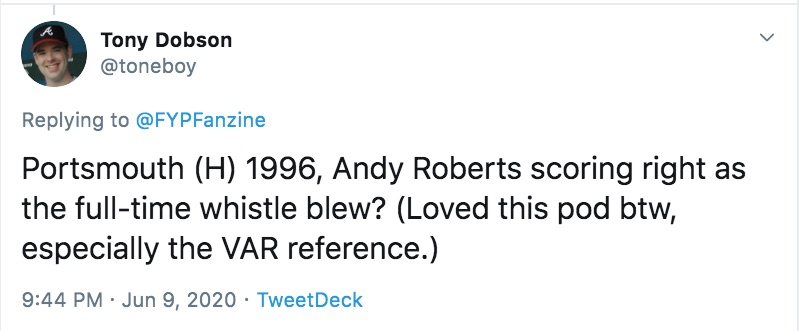
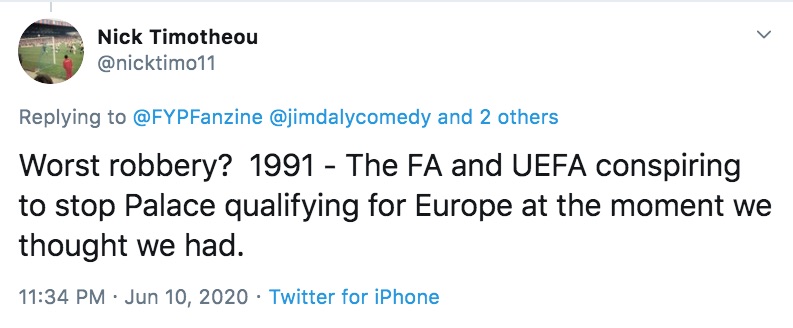
Then we go to Twitter where listeners were quick to add their selections... 

Any we've missed? Tweet us @FYPFanzine or email us This email address is being protected from spambots. You need JavaScript enabled to view it.


Fantasy Premier League Crystal Palace Picks for June 2020

Written by Alex Roll
Want to pick a Palace player in your Fantasy Premier League side but not sure who? Alex Roll is here with his expert pick.

You have to cast your minds back to Saturday 7th March for Crystal Palace’s last Premier League fixture – a fine 1-0 home win over Watford in Gameweek 29.

Due to ongoing events, the majority of the footballing world has been put on hold with Germany’s Bundesliga and Spain’s La Liga being amongst Europe’s elite leagues to restart their calendars in recent weeks.

With the resumption of the Premier League this Wednesday, it is time to dust off the Fantasy Premier League app, download any required updates and make your selections for Gameweek 30.

It should be noted that you may make unlimited transfers before Wednesday without using your Wildcard! 


The remaining weeks of June present The Eagles with 3 fixtures: Bournemouth (GW30), champions in waiting Liverpool (GW31) and Sean Dyche’s Burnley (GW32).

With no form to go by and a healthy squad to choose from, Roy Hodgson will face a selection headache and has made no secret of daring to blood youngsters in the remaining PL fixtures.


My Crystal Palace player pick for June is Gary Cahill (£4.4m) who, before the suspension of the PL season, partnered Scott Dann (£4.3m) in the heart of the Eagles’ back line which saw us amass 3 clean sheets in a row (GW27-29 – Cahill receiving a total of 18 points).

All associated with Palace will be eager to hit the ground running, continue our solid defensive performances and look to finish the season strongly.

An additional Palace defender who would be an astute purchase is Patrick Van Aanholt (£5.6m) who also featured in the aforementioned Gameweeks, whilst also scoring the winner against Newcastle (15 points awarded for GW27).

His attacking influence and ability could prove beneficial in the forthcoming weeks.


Come on you Palace!


Listen to the latest FYP Podcast below...


The night Puskas and Di Stefano lit up Selhurst Park

Written by Jo Harman

Jo Harman takes us back to an historic night at Selhusrt Park when Puskas, Di Stefano and the great Real Madrid side visited little Crystal Palace


Nearly 60 years on, it’s difficult to comprehend how the match even took place. Real Madrid, crowned the best side in Europe in five of the previous six seasons, arrived at ramshackle Selhurst Park on April 18, 1962 to take on Crystal Palace, sitting in the lower reaches of the Third Division, just a fortnight before playing Benfica in the European Cup final. 

And Real weren’t giving their stiffs a run out. Ten of the side that would start against the Portuguese champions two weeks later in Amsterdam turned out on a wet and windswept Wednesday evening in SE25, presumably wondering if this was really the best preparation for one of the biggest matches of their lives.

The Spanish giants’ galácticos of the time included the Hungarian genius Ferenc Pusk
ás, 1960 Ballon d’Or winner Alfredo Di Stéfano, midfield schemer Luis del Sol, and their captain Paco Gento, a nippy outside-left and bona fide club legend who went on to replace Di Stéfano as Real’s honourary president in 2016. All four started against Palace, and only del Sol was spared the full 90 minutes as torrential rain beat down in South London.

The match was the brainchild of Arthur Wait, Crystal Palace’s audacious chairman. A Croydon-born builder, Wait was a lifelong Palace supporter who would sneak into the ground as a young boy when his brother wasn’t around to take him to matches. As his business grew, so did his influence on the club he loved. By the late forties he had secured himself a place on the board. By 1958 he was chairman, determined to propel Palace into the top division for the first time in their history.

Embed from Getty Images


Progress was slower than Wait would have liked though. After finishing 14th in Third Division South in 1958, Palace found themselves in the newly formed Fourth Division. It took them three seasons to escape the basement of English football, former Tottenham boss Arthur Rowe eventually leading them to promotion in 1961. 

Rowe is credited as devising and developing the ‘push-and-run’, or ‘give-and-go’, style of play, and under his guidance Spurs won their first ever league title in 1951. He was forced to step down four years later after suffering a nervous breakdown before Wait coaxed him back into football soon after becoming chairman, first as assistant to George Smith and then, when Smith was sacked in 1960, as first-team boss. 

Following Rowe’s death in 1993, Reg Drury of The Independent described him as having “one of the sharpest soccer brains the English game has ever known”, and he quickly made his mark on Palace who, despite their lowly position, began to play with a newfound fluency. 

Finally on an upward trajectory, Wait wanted the club to capitalise on their promotion and announce themselves as London’s up-and-coming side. After upgrading Selhurst Park’s floodlights, installing four 100-foot pylons at a cost of £18,000, the chairman sensed an opportunity to demonstrate the club’s ambition and recoup some cash at the same time. What better way for the fans to experience the new floodlights, he thought, than to see them illuminate a match between Palace and elite opposition. 

In The Crystal Palace Story (1969), Roy Peskett writes that the club approached an unnamed first division side from the north of England, who were offered expenses and “a luxury weekend by the seaside for players, directors and officials”, only for negotiations to break down after their proposed opponents insisted on a £3,000 guarantee. “If that’s what they are going to do to us, we might as well try to get Real Madrid,” said Wait. So that’s what he did.

Real, who had never played a game in London before, let alone against third-tier opposition, would clearly take some persuading, and Palace enlisted the help of George Sturrup, an agent who had close connections with the Spanish club. 

Improbably, a deal was struck, but Palace had to dig deep in their pockets to make it happen. Wait, finding the lure of hosting the most successful team in Europe irresistible, forked out £10,000 for the privilege (for context, the British record transfer fee at the time was the £85,000 Inter Milan paid for Aston Villa’s Gerry Hitchens in 1961) and there must have been butterflies in the stomachs of the club’s directors as 48 hours of heavy rain ahead of kick-off threatened to make a damp squib of the big day. 

They needn’t have worried. A crowd of 24,470 braved the conditions for the chance to watch Pusk
ás and Di Stéfano in the flesh, paying 10 shillings per head as Palace took a club record £15,000 on the turnstiles and made more than £3,000 on the night. Even before the Spanish Ambassador ceremonially ‘turned on’ the lights, it was clear that Wait’s entrepreneurial instincts had been spot on.   


Palace’s chairman could be forgiven his self-congratulatory programme notes. “It is with pride that we welcome the Real Madrid team and officials tonight,” he wrote. “We feel honoured that the greatest club team in Europe should agree to officially open the magnificent floodlights installed at the beginning of this season. This is the first time that Real Madrid have played in London, or indeed anywhere south of Manchester, so forgive us if we throw our chests out a little for being able to arrange such a fixture. It needed quite a lot of courage."

One of those in attendance was John Carter, a lifelong Palace supporter who went to his first match at Selhurst at the age of four and still has a season-ticket today. “Can you imagine?” said Carter, who was 19 at the time. “They had all these world-class stars. We were thrilled to see Puskás and Di Stéfano. Boy, were they good players. Puskás was the most amazing player because he was a little chubby bloke and if anybody didn’t look like a footballer it was him. Every touch he had, he was just brilliant.”

The return of a homegrown hero gave the Palace supporters added reason for excitement. Only five weeks earlier Johnny Byrne had left the club for West Ham in a cash and player exchange deal worth £65,000 but Wait shrewdly insisted on a clause which made the 22-year-old available to play in the exhibition match against Madrid. 

Byrne had made his international debut against Northern Ireland the previous November – making him one of only five post-war players to represent England while playing outside the top two divisions – and was considered unlucky to have missed out on selection for Walter Winterbottom’s recently announced 1962 World Cup squad. Against Real he would show why he was regarded by many as one of the most exciting strikers of his time.

Turning out for Palace alongside Byrne was Ron Brett, a former West Ham forward who had been the makeweight in Byrne’s switch to the Hammers. But while Byrne’s career was just beginning, Brett’s would shortly come to a tragic end. Five months after his switch to Selhurst Park, Brett was killed when his car was hit by a lorry in Clerkenwell and the match against Real would be one of his final appearances. “Arthur Rowe was particularly upset, not only for the useless waste of a young life, and the loss to his family, but because he had high belief in Brett’s capabilities,” wrote Roy Peskett. When Rowe resigned as manager in December 1962 due to ill health, Brett’s death was cited as a contributing factor.

Given the gulf in quality between the two sides, a flood of goals to match the inclement weather was expected, and Real duly opened up a two-goal lead in the first eight minutes, Di Stéfano heading home a chip from Justo Tejada before Gento lashed home after a poor clearance. “Real Madrid settled down like peacocks to show their feathers on a wet English night,” reported The Times.

Against the run of play Palace halved the deficit when a cross from Byrne was headed in by Ron Heckman but Real threatened to blow their hosts away with two further goals before half-time. The third came direct from a Puskás free-kick and the Hungarian was also influential in the fourth, exchanging passes with Di Stéfano in the Palace penalty area before the right-back Isidro was teed up for the simplest of finishes.

“At half-time, with Madrid 4-1 ahead, one realised the depth of their knowledge, how used they are to the game at whatever level it is played,” wrote The Times. “One felt here were adults talking to adolescents.”


Rowe made a surprise substitution at the interval, taking off the experienced goalkeeper Vic Rouse and asking Bill Glazier, a 19-year-old with no previous first-team experience, to keep the most formidable frontline in world football at bay. 

A former member of Torquay United’s groundstaff, Glazier had joined the club on trial four months earlier – an arrangement supposedly set up between Palace’s captain Johnny McNichol and the Glazier family’s bread delivery man, who were close friends. The teenager had impressed for Palace’s reserves, earning a full-time contract, but would have been a new name to the vast majority of fans as he set up position between the sticks for the second half. 

“Real Madrid! That is my most exciting match and memory in my football life to date,” Glazier later said. “Like all footballer and football followers, I had read and heard about Real Madrid. I had also seen the Real Madrid versus Eintracht Frankfurt European Cup final film [from 1960, a match won 7-3 by Real], but it was beyond my wildest dreams to think that I should ever play against this great side.

“When we heard at the club that a game versus Real was a possibility, I think many of us thought that it was a bit of a leg-pull! Still, the game was fixed, and the day before the match I had a big thrill in seeing my name in the team group of players.

“The first 45 minutes did indeed show Real as a great side… And at this stage we did not seem to have much of a chance. When I was told at half-time to take over in goal from Vic Rouse I certainly felt – a bit more than excited! Luckily, when the game did restart, I was very quickly brought into action and this helped me quite a lot, to settle in my game. A wonderful memory, always for me, to have played against some of the finest players of this age.” 

The Times described “magnificent goalkeeping by the youthful Glazier”, who pulled off three wonderful saves to prevent Real extending their lead. It proved a defining match in the shot-stopper’s career, as he went on to replace Rouse as Palace’s first-choice keeper by the end of the season.

Glazier made 106 appearances for the club before moving to top-flight Coventry City in 1964 when Jimmy Hill forked out a then world-record fee for a goalkeeper of £35,000. 

As Glazier held firm, Palace – who were on a winless streak of nine league matches – began to grow in confidence. They were rewarded for their enterprise 10 minutes after the break when Andy Smillie converted a pass from Roy Summersby to make it 4-2 before a 25-yard thunderbolt from Terry Long sent the home crowd into delirium and reduced the deficit to a single goal.


Perhaps with the exception of Byrne, there could not have been a more popular goal-scorer on the night than Long. A one-club man, he spent 16 seasons at Palace between 1955 and 1970, amassing 442 appearances – including at one stage a sequence of 214 consecutive matches – and playing in four different divisions, but never the top flight. 

“He didn’t score many goals,” said John Carter, who was stood in the Whitehorse Lane Stand as Long’s long-range strike nestled in the back of the net. “But he did a hell of a lot of running. He was a box-to-box player, a bit like James McArthur today.”

Suddenly, Real were on the back-foot. In a little over an hour, the Spanish side had conceded as many goals against the third-tier south Londoners as they had in the entirety of their run to the European Cup final. And this was not a case of Real surrendering for the sake of appearances. The free-kick count against them reached double figures as they dug in to protect their lead, with Byrne, who produced a scintillating performance, drawing many of the fouls. 

“We were now on top of our game,” recalled Glazier. “The match was fought grimly to the end, and to our delight, we were doing the forcing and it always seemed possible that we could get an equaliser. However, the other goal would not come and the game finished at 4-3 for Madrid, in a match that was as close as the score.”

After the final whistle Real’s coach Miguel Muñoz said he was shocked that Byrne had been overlooked for England’s World Cup squad, while José Santamaría, the no-nonsense Uruguayan centre-back who was nicknamed ‘The Wall’, said: “He was one of the most difficult players to stop I have ever played against.”

Just 48 hours later Byrne – known as ‘Budgie’ for his incessant chat – turned out for West Ham in a Good Friday fixture against Cardiff City at Upton Park and scored his first of 107 goals for his new club. Described by Hammers boss Ron Greenwood as ‘the English Di Stéfano’, he played 11 times for England and scored eight goals, including a hat-trick against Eusébio’s Portugal in Lisbon in 1964. Were it not for injury, he would most probably have featured in England’s 1966 World Cup squad. 

Palace were lauded for the courageous style in which they played and for the occasion itself. “Crystal Palace invited Real Madrid along to Selhurst Park last night to give their new floodlights an official blessing,” wrote the Daily Telegraph and Morning Post, “and then, somewhat inhospitably, rubbed a little glitter off the world’s most glamorous football club.”

The reporter for The Times was even more effusive. “This was a night to be savoured by all those who made the effort to reach Selhurst Park, prepared to see great players in the flesh rather than within the framework of a television set. Real Madrid had come to London for the first time; the Spanish Ambassador had officially declared the floodlights open: and may we hope that the legends of the great Spanish side will inspire Crystal Palace to new life. This night at least they took one step towards it.”

The match had been an unqualified success, and a feather in the cap for Wait, but Palace’s progress wasn’t exactly rapid from that point. They finished the 1961-62 season in 15th place, only six points clear of relegation, and came a middling 11th the following year. In 1963-64 they secured promotion to the Second Division, with their impressive young keeper Bill Glazier ever-present, before finally realising Wait’s ambition of top-flight football in 1969. The chairman celebrated by signing off on a new stand and was regularly seen putting his builders’ hands to good use, working on its construction. The Arthur Wait Stand still exists today (although this writer, and any away fan you’ll speak to, can confirm it could do with a bit of work).

As for Real, they’ve featured in 11 European Cup finals since their visit to Selhurst, losing just three – one of those defeats coming two weeks after going toe-to-toe with Palace. Whether Eusébio picked up on the frailties in Real’s defence exposed by a marauding Terry Long, or perhaps the Spanish giants were feeling a little leggy after their trip to south London, Benfica ran out 5-3 winners after scoring three second-half goals. 

(Incidentally, Real’s visit to Selhurst isn’t their only match against third-tier English opposition. In July 2013, two months after winning promotion to the Championship, Bournemouth hosted a Madrid side featuring Cristiano Ronaldo, Luka Modrić and Mesut Özil. The Cherries charged up to £60 per ticket, reportedly paid their opponents £750,000 and were thumped 6-0.)

The Blizzard: Issue 37 of The Blizzard is out now. Subscribe from as little as £20 at theblizzard.co.uk and enjoy access to more than 700 articles.

 Jo Harman is a sportswriter and magazine editor of Wisden Cricket Monthly. He tweets @Jo_Wisden