Everton Performance Proves there is More to Crystal Palace's Attack than Season has Shown

Written by Robert Sutherland
Bats1
 
Crystal Palace have not been entertaining this season. Like an Eastern European tower block or brutalist architecture, the house that Roy Hodgson has built -- all straight-edged and set like concrete -- is accomodating only to the purpose it is intended to serve -- it's not meant to look nice, it's just meant to stay up. And in this case, the bare minimum has been to achieve safety. Palace, with their strong foundations and their ugly simplicity, have been utilitarian in the extreme, but the manager will say with justification that this was the goal he was set, and he has met it.
 
There is however a case to be made that, in being so very focused on securing the points by limiting what opponents can do, Palace haven't made the most of what they have in attack. Yesterday's forward play, driven by the guile of Eberechi Eze and the verve of Wilfried Zaha, was a rare highlight in an a mostly forgettable season of attacking performances. Palace drove forward with pace and intent, showing a directness towards Everton's goal that has, on so many occasions, been disrupted by meandering play  in the middle of the pitch. 
 
Much of the argument in favour of Hodgson's tactics this season has been grounded in the lack of options for the manager to choose from -- Palace can't possibly play on the front foot because they don't have a capable staff. But yesterday's draw showed that putting a little more faith in the players signed to score goals can and should pay dividends. It also doesn't ring entirely true that Palace are limited -- some of the problems faced this season have come down to the manager's inflexibility in his approach. 
 
As a striker, Zaha has been effective this season, as emphasised by the nine goals he has scored in a side that doesn't really create a significant number of chances. But in playing Zaha in such a central attacking role, rather than one of freedom across a front three, it negates one of the other key elements of his game, and his previous contributions to Palace. For so many past seasons, Zaha has been the most creative player in the side. 
 
His quality over the course of his Palace career isn't just grounded in his goalscoring ability -- he was never just a goalscorer prior to this season -- but that he can create chances too. As a winger, or a drifting attacking player, Zaha's creativity and unpredictability has made him a huge threat for opponents. A threat which, in a number of games this season, has been snuffed out with some tight marking and aggressive tackling.  
 
Wilf Watford
 
Zaha's inclusion as a striker also limits who he prefers to play alongside or around him. Christian Benteke has had a much-improved season, but his inclusion is often predicated on whether Zaha is in the side with him. There's been some talk of them forming a partnership of sorts, but the statistics suggest that isn't the case -- neither really create goals for each other, nor has the inclusion of one alongside the other been indicative of a resoundingly-positive attacking performance.
 
This is where, in Michy Batshuayi's case, he has some grounds for frustration. The manager doesn't trust him to play alongside Zaha in attacking pairing, but he also won't change the line-up to accomodate or make the most of the qualities Batshuayi exhibits. 
 
The Belgian striker, on loan from Chelsea, has made just seven starts for the side, with the majority of his appearances coming as a substitute, with an average of 15-minutes per substitute appearance. No player is likely to really make the case for further inclusion with such limited time on the pitch, in a side which doesn't truly accommodate that player's needs. 
 
The frustration for Batshuayi will also be amplified by the fact that, in his first loan spell, the manager utilised tactics that better suited his talent, often as a central striker in a front three. The outcome was that he scored six goals in 12 appearances for the side. 
 
Roy ray
 
Jean-Philippe Mateta is likely to also face similar difficulty for the remainder of this season. Palace have secured the Mainz striker on an 18-month loan deal, in the hope that he will do enough to warrant his permanent signing either during or at the end of that spell. But he will be expected to play a role that is unlikely to really create the kind of opportunities he can make the most of. 
 
Palace haven't been a creative side this season. They average just 8.8 shots per game, with only Sheffield United and West Brom performing worse. Of those shots, an average of 3.2 are on target per game, again putting Palace among relegation-threatened sides. Palace are also the team that spends the least amount of time in the opposition's third, with just 24% of the team's play taking place there. 
 
These statistics support the case that Palace aren't as effective in attack as they perhaps should be, given the attacking talent they have. Hodgson's tactics have put a lot of burden on strikers to create opportunities out of nothing, and while Zaha is capable of this, there have been times this season where playing him as a winger or as one of three attacking players, and allowing another striker to take that central role, might have been more fruitful and crucially more entertaining. 
 
The manager's conundrum is that he has to do what he sees fit in order to achieve the goals he is set. Hodgson is never going to approach matches with a gung-ho style, but Palace's performance yesterday proves there is more to football than just squeezing the life out of opponents and hoping you make the most of the limited chances you have. Palace have the players to be more aggressive -- the manager just needs to find a way to accomodate them. 

For Crystal Palace, Ambition Should Not be a Taboo Word

Written by Naveed Khan

arthur 640

Roy Hodgson emerged from the scoreless draw against Fulham to say he was “very pleased with the performance” despite having a meagre three shots over the 90 minutes with none on target. In many ways a fitting comment a week or so after he said fans who wanted the club to show some drive should be “careful”.

Hodgson cited Charlton Athletic by way of a warning for fans who has asked the players show more energy on the pitch, a misguided pushback from the Palace manager, given Alan Curbishley himself provided year after year of top half finishes – something he has not achieved.

The fans are not asking for strong top half finish, let alone a European qualification spot. They aren’t asking for the club to spend £100s of millions, or to play a fusion of tiki-taka and gegenpress. The wish is simple – with the squad he has at disposal, to have more than 35 efforts on goal in a month, have more than 22 shots on target in 11 games and perhaps score a goal in a cup.

A lot has been made about Hodgson being a Croydon boy and a Palace fan. There is no doubt that is true, but despite those long-rooted links to the club, the way he sets his teams up to play only points to him not understanding the club or the fans.

The focus against Fulham was not to get 13 points ahead of them. Instead, it seemed from the moment the match started to keep the gap to 10 points. Attacking players were instructed to stop Fulham playing rather than letting Eberechi Eze, Jordan Ayew and Andros Townsend try and hurt their opponent. Rather than letting Christian Benteke be the focal point of our attack, his role was to be the focal point of our defence. The aim for him was not to score goals, it was to stop Fulham from starting plays from the back. Understandable against some opponents, sure. But against a promoted side in the bottom three who had won four games all season?

Benteke miss

This is the crossroad of ambition that Crystal Palace find themselves at – and where Hodgson misunderstands what exactly ambition is. For the manager and those still ingrained in their support of him, four points from two games without Wilfried Zaha is a good outcome. For others, while the points return is good, the process has not been – two shots on target in 180 minutes against two sides below Palace in the table. It is not sustainable and it is stifling.

For some, the counter to the above will simply be to look at the points return. Yes, it is the best at this point since promotion to the Premier League. And there is a comfortable cushion to the bottom three. But all of that makes the point for ambition more – without being in a scrap for points, why is the football so guarded? Why is there such rigidity in formation? Why is there little squad rotation? Why, when a game against an opponent in the bottom three is 0-0, is Hodgson’s first substitution to bring on a defensive midfielder for an attacking one?

Ambition is not a taboo word, and no manager should be shaming the fanbase for having whatever ambition they see fit. Palace fans in this instance are not asking for a lot – just some hope on the pitch, some escapism from a pandemic-ridden world and some wing-play. That is our ambition; if the manager sees that and warns us to be “careful”, then it is a huge indicator that we are not a good match anymore.

We Are Not Entertained But What Choice Do We Really Have?

Written by Carl Mortimer

I have resigned myself to accept that this is Palace right now.

Palace are tedious to watch at the moment, and I’ve sat through The Masked Singer and all the Twilight films, but nothing will be worse than watching a Palace game right now.

It’s a chore, you know there’s a Palace game coming and it’s going to be on telly, you see the line up, you hope for 4-2-3-1, you want to get excited for it, but you just can’t.

Being in lockdown with no one being able to go and enjoy the matchday experience isn’t helping right now but, if anything, that’s probably a good thing with how Palace play their football under Roy Hodgson. Can you imagine the anger in the stands if fans were able to go and watch us play right now?

After losing a game with no shots on target, no real clear-cut chances, no excitement and no game changing substitutions I would get angry and annoyed, and would vent at anyone and everything -- just because Palace have ruined my weekend. However, I’m in a place now where I know what’s going to happen so I prepare myself quite early on, and if we win, it’s a bonus.

I’m not on Twitter anymore, which definitely helps keep that Palace related anger/annoyance in check, as that was my go-to platform to vent obscenities. My wife doesn’t care for my rants as she doesn’t have a clue why I’m so angry, and my dad, although slightly pissed off seems to accept it for what it is too.

READ MORE: Leadership Vacuum and Boardroom Disconnect Risks Supporter Apathy

Our football under Roy Hodgson is dreadful, no denying it. And yes, there are injuries and a lack of transfers etc etc but that doesn’t excuse the fact that even with a full strength side we still struggle to muster a single shot on target in some games. I don’t buy into those excuses -- we are just more concerned about our opponents than with playing our own game.

We have to accept the fact that this is just Palace under Hodgson and no amount of venting into the cloud is going to change that.

Palace will win a game, draw a game, and then lose a game. There will be games where we have one shot and win a game one-nil, and another where we have no shots and lose one-nil – they won’t be pretty win or lose, but we just have to accept that under Hodgson this is how it’s going to be. There is no point in getting angry or annoyed at it, it won’t change until he steps down or doesn’t get a new contract.

We all want Roy to change this and that, play this player, switch it up, do something different but it just isn’t going to happen, I say to the FYP WhatsApp group “I don’t expect anything to change until Roy leaves” and I’ve now accepted it, win lose or draw, I don’t get carried away anymore.

I don’t want to accept it, I want to get excited for a European tour when we win a couple of games but, I know the likelihood is, we will lose or draw the next couple and the cycle starts again.

I know that as a club and a squad of players we can play better football than what is currently served up, but until that time we all just have to accept the mediocrity of the manager’s ways until that change happens. What’s the point in getting angry about something we cannot change?

Roy is here whether we like it or not, and unfortunately, we just have to ride this boredom train until it departs.

Listen to the latest FYP Podcast below...


Crystal Palace's Contract Conundrum is a Storm on the Horizon

Written by Robert Sutherland

Robert Sutherland looks at the club's contract situation, with a significant number of players nearing the end of their deals, and the manager also in limbo about where his future lies. 

Benteke hands on head

The headlines this week have focused on a massive storm hitting the UK, but in South London, there's an entirely different kind of storm brewing on the horizon, and while Crystal Palace have ample warning to prepare for its arrival, there are matters which are complicating the club's response to it. 

Like a government that can't decide whether to invest long-term in building permanent flood barriers or whether to go with the short-term solution of putting down some sandbags in the hope they'll suffice, Palace are now in a situation where, with contracts expiring for key members of staff and the playing squad, they aren't sure about which solution is best at this point. 
 
The most pressing issue right now is that of the manager. Roy Hodgson's contract expires at the end of June and it seems the club is unlikely to extend it. Despite a 23-point total at the half-way point of the season, there have been issues with some of the team's performances in recent months which, added to the wholly disappointing end to last season, look like they might have encouraged Steve Parish, Josh Harris and David Blitzer to look elsewhere for their coaching inspiration. But as Hodgson's contract ticks down, it brings difficulty in terms of recruitment of players, and determining exactly who of the ten or more players with expiring contracts is worthy of a new deal. 
 
Roy ray
 
There has to be a basic level of sensibility about new contracts. The club has to have a minimum number of players available to whoever the new manager is next season, and this means that some players will likely get new deals when you might otherwise not give them. Andros Townsend, James McCarthy, Christian Benteke, Joel Ward, Patrick van Aanholt, Gary Cahill and Mamadou Sakho are the most glaring contractual questions, all of whom are unlikely to take pay cuts. 
 
At a time where Palace are trying to streamline the squad by reducing the number of big earners in the team and perhaps seeking to distribute their wage outlay more reasonably to improve the average ability of the side, offering new deals to older players -- some of whom have contributed significantly and some of whom haven't -- is going to be counterproductive to such a goal. When you add in Connor Wickham and Scott Dann, it becomes even more stark an issue -- the club will need to spend a huge sum of money to just replenish the side, let alone rebuild and improve it. 
 
The further dynamic to add into the mix is whether a new manager they appoint is willing to work with the players to whom they've awarded new deals. The players mentioned won't just want monetary reward, they will want assurances that they are going to play football, and they will want the security that two or three-year contracts bring. It's not an unreasonable expectation for these players, some of whom have dedicated a significant portion of their career to the club, that they get contracts that don't just keep them at Palace, but that reward them for that contribution. 
 
For Palace, a club that hasn't really been one for long-term plans generally, even this is an extreme scenario. It's often the case that Palace have allowed contracts to near expiry before they decide to renegotiate and reward. But it's never been the case that 40% of the entire playing squad could leave at the end of the season for nothing, with low-cost replacements in the current market typically priced at £10m or more, and the kind of players likely to improve the Palace team requiring significantly more investment. That's a potential outlay of around £100m that the club would need to commit to -- at a time where income from off-pitch activities has been severely impacted by the COVID-19 pandemic. It's that, or a matter of inventive transfer deals and scouring the market for free transfers. 
 
Ward crop
 
The answer to this situation isn't an easy one. On the management side, there is always a risk that if they persist with Hodgson until the end of the season, any potential managerial target they have is at leisure to sign for another club. The alternative is that they offer Roy Hodgson another contract and ultimately kick the can of uncertainty down the road until his contract nears expiry once again. Palace didn't renew Hodgson's last contract until March of last year, so by that metric there is still time for such a decision to be made. 
 
On the playing squad side of things, there will have to be a balanced approach to contract renewals, with the tipping point being whether the player has provided value for the outlay of their contract over the length of their existing deal. Players like Joel Ward would likely be worthy of a new deal as his on-field contributions have made his contract a worthwhile investment. In contrast, the same can't be said for Mamadou Sakho, whose Palace career has been blighted by significant spells out of the side due to injuries. Sakho's contract hasn't been value for money, whereas Ward's has. It's also a matter of determining whether the players they offer contracts to can still make a material difference to the side. These are decisions you would typically make with the manager -- but in this case, even the manager doesn't know whether he is needed. 
 
It looks like the club have started to address the playing squad issue this week with the arrival of Jean-Phillipe Mateta on an 18-month loan with an obligation to sign him permanently should he meet expectations. For Mateta to succeed, he will have to play games and will have to be given the chance to impress. Should he do that, it seems that his arrival will signal the departure of Benteke during the summer. One player down, nine more to go.
 
The season ends in four months. The club still has time to fine-tune their strategy, but it'll take decisiveness and ruthlessness to be effective. The first piece in the puzzle must surely be whether to replace Hodgson or to give him a new deal. Then you can determine who it is best to give new contracts to. The alternative is that they persist for the next few months without that clarity, and in doing so are left to renew player contracts without knowing whether a new manager will want them. 
 
Whatever the decision, its not an enviable position for the club to find itself in. But Palace have had an ability to fight their way out of these situations before, so you have to have some faith that they'll do it again this time. 

Leadership Vacuum and Boardroom Disconnect Risks Supporter Apathy

Written by Naveed Khan

Roy wet clap

As a club, Crystal Palace find themselves in an arduous place.

Thirteenth in the league table over halfway through the season, 11 points clear of the bottom three. Stepping away, it seems a club which has not spent fortunes in the transfer market is being well run and the manager doing a good job.

Stepping in, the picture looks different. Palace ended the 2019/20 season with eight defeats in nine games. They are currently on a run which has seen a solitary win in ten games, which came against lowly Sheffield United. This run includes a 7-0 defeat at home, a 4-0 defeat as well as a 3-0 defeat against a team which played for more than a half with a man sent off.

Added to this, the manager and some core players are in the final months of their respective contracts at the club.

Put this together with the global pandemic and fans absent from stadia, and the picture is uncertain and muddy. All of this exposes a real lack of leadership, on and off the pitch.

On the pitch, the days of Damien Delaney and Mile Jedinak holding the team together seem a distant memory. Roy Hodgson’s current group of leaders, including Luka Milivojević, James McArthur and Gary Cahill do not evoke the same responses from their team-mates, nor do they seem connected with the fans. And where Jedinak and Delaney would not have been shy of challenging their manager or even the Chairman if things were not working, the sense is not there that this group would challenge Hodgson and his methods.

Jedinak thumbs up

Off the pitch, Hodgson’s contract situation adds to the uncertainty and plays in the cycle of the leadership vacuum. That is not a call for his contract to be extended, far from it. It is more the reason, added to the form, to make the change in manager sooner rather than later.

With some players also coming close to the end of their contracts and a squad evolution starting as evidenced by the signing of Jean-Philippe Mateta, the players will also need to know who their manager will be coming into next season. A lack of clear leadership in this area could cost the club targets and also players who are weighing up their options.

One of the things then went hand in hand with the likes of Jedinak and Delaney challenging the leadership while demonstrating their own was CPFC2010 communicating quite openly with fans. The change in ownership in 2015 brought with it a change in dynamic – the ownership went from of the fans to of the boardroom. That is not a criticism, it is more likely a reality of the new shareholders and being established in the Premier League. But that meant the distance between the fans and the club grew. The leadership we could reach out to was no longer there.

The combination of all of the above highlights a real vacuum of leadership at the club. Something needs to change and in these times it is unlikely to be the ownership or a flurry of new players. That leaves the manager.

Hodgson is generally seen as a safe pair of hands, but he has overseen some awful runs of form over the last year. The last 38 games have yielded 1.03 points per game – enough to survive but a lot for the fans the endure. This season, one of Palace's major strengths -- the defensive thriftiness so often associated with the manager -- has vanished -- the club has the second-worst defensive record in the league.

There is little doubt that he was the right man for the job from 2017 to 2020, but is he the right man to oversee squad evolution and reinvigorate the club? Is he capable of being the link from the boardroom to the fans? And if the answer is no, why wait until the summer to make that call?

Until this is addressed, Palace risk seeing the anger of the fans turn into apathy. Anger you can recover from. Apathy, not so much.

Is It Safe? The Fallacy of the 40-Point Urban Myth

Written by Julian Chenery

Julian Chenery takes a look at the numbers behind the much-vaunted 40-point safety mark that is often brought up by pundits during relegation battles, and finds that the tally needed to stay up is typically less. 

Celebrate

“Is it safe?” repeated Laurence Olivier’s Nazi dentist Christian Szell while drilling down into Dustin Hoffman’s root canals in Marathon Man. “Is it safe?”

Much the same question is played out on the lips of Palace fans each year, who are tortured by the annual survival race. “Are we safe?” – more to the point “WHEN are we safe?”

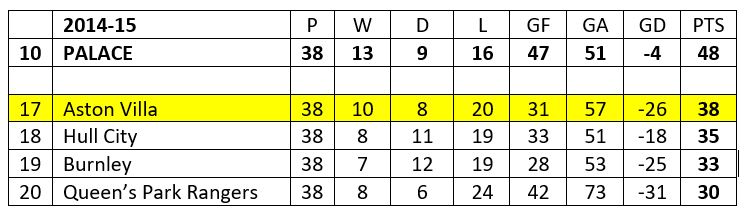
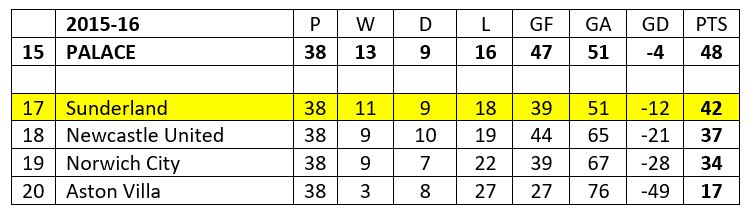
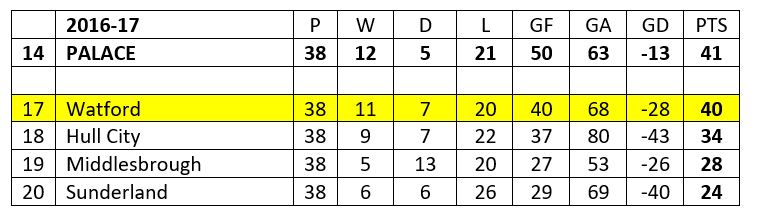
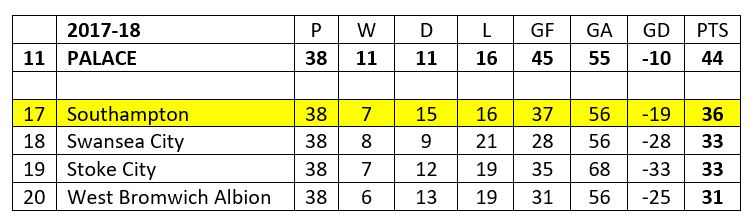
However, believe it or not, it’s an urban myth that a team needs to reach the 40 point mark to guarantee avoiding the drop. The reality is that in each of the seasons since Palace’s return to the top flight, a much lower points total has usually sufficed.

So as some Palace fans remain as ‘relaxed’ as a ‘Better tweet Street’, or agree with Bob ‘aiming for 10 wins’ White, or as Kevin Day does, prefer the calculations on a crumpled piece of paper – we aim to uncover what, where and when it is safe.

Let’s start with some basic numbers. Here are the bottom three relegation positions since Palace’s first season back in the Premier League in 2013-14, along with that of the lowest surviving team.

JC Table 1

POINTS REQUIRED FOR SAFETY = 34
POINTS ACHIEVED BY 17th PLACED TEAM = 36
NUMBER OF POINTS PALACE ACHIEVED ABOVE TEAM RELEGATED IN 18th = 12
NUMBER OF PLACES PALACE FINISHED ABOVE TEAM RELEGATED IN 18th = 7

JC Table 2

POINTS REQUIRED FOR SAFETY = 36
POINTS ACHIEVED BY 17th PLACED TEAM = 38
NUMBER OF POINTS PALACE ACHIEVED ABOVE TEAM RELEGATED IN 18th = 13
NUMBER OF PLACES PALACE FINISHED ABOVE TEAM RELEGATED IN 18th = 8

JC Table 3

POINTS REQUIRED FOR SAFETY = 38
POINTS ACHIEVED BY 17th PLACED TEAM = 42
NUMBER OF POINTS PALACE ACHIEVED ABOVE TEAM RELEGATED IN 18th = 11
NUMBER OF PLACES PALACE FINISHED ABOVE TEAM RELEGATED IN 18th = 3

JC Table 4

POINTS REQUIRED FOR SAFETY = 38
POINTS ACHIEVED BY 17th PLACED TEAM = 42
NUMBER OF POINTS PALACE ACHIEVED ABOVE TEAM RELEGATED IN 18th = 11
NUMBER OF PLACES PALACE FINISHED ABOVE TEAM RELEGATED IN 18th = 3

JC Table 5

POINTS REQUIRED FOR SAFETY = 34
POINTS ACHIEVED BY 17th PLACED TEAM = 36
NUMBER OF POINTS PALACE ACHIEVED ABOVE TEAM RELEGATED IN 18th = 11
NUMBER OF PLACES PALACE FINISHED ABOVE TEAM RELEGATED IN 18th = 7

JC Table 6

POINTS REQUIRED FOR SAFETY = 35
POINTS ACHIEVED BY 17th PLACED TEAM = 36
NUMBER OF POINTS PALACE ACHIEVED ABOVE TEAM RELEGATED IN 18th = 15
NUMBER OF PLACES PALACE FINISHED ABOVE TEAM RELEGATED IN 18th = 6


JC Table 7

POINTS REQUIRED FOR SAFETY = 35
POINTS ACHIEVED BY 17th PLACED TEAM = 35
NUMBER OF POINTS PALACE ACHIEVED ABOVE TEAM RELEGATED IN 18th = 9
NUMBER OF PLACES PALACE FINISHED ABOVE TEAM RELEGATED IN 18th = 4

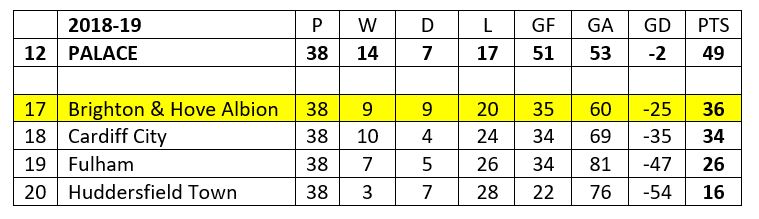
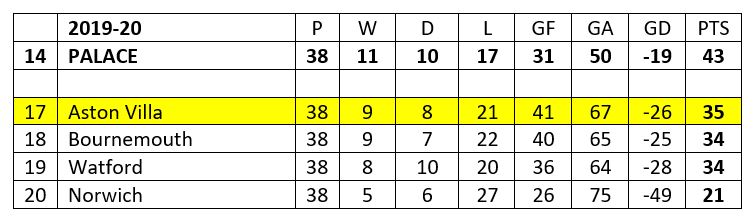
Did you enjoy all that? From this extremely statistically-basic measurement of what is needed to stay up, you can see that in the seven seasons since Palace were promoted that the points required to avoid the drop have ranged from 34 (twice) to 38 (once). 35 points were needed three times and 36 points once.

In each of those seasons, the team that finished seventeenth actually reached between 35 points (once) and 42 points (once). Of the remaining five clubs, 36 points were reached three times, 38 points (once) and 40 points (once).

So, at no time in the last seven seasons has a team needed 40 points to survive.

The lowest survival mark has been 34 points in 2013-14 and 2017-18, and the lowest points total achieved by a team finishing seventeenth has been 35 in 2019-20.

The highest survival mark has been 38 in 2015-16, and the highest points total by a team finishing seventeenth has been 42 points by Sunderland in 2015-16.

So far as Palace are concerned, we’ve finished between tenth with 48 points (2014-15) and fifteenth (2015-16) also with 48 points!

In that time, we’ve finished between eight (2014-15) and three positions (2015-16) above the drop zone, with a points gap ranging between fifteen (2018-19) and seven points (2016-17).

So, when ‘is it safe’?

In all but one season, a level of around 36 points has meant survival, ie four points lower than the oft-touted forty.

When finishing a secure seventeenth in 2016-17, Watford did in fact achieve the magic 40 mark – but this was six points above eighteenth-placed Hull City.

After six rounds of the 20-21 season, we are sitting happily on 10 points. After 15.8% of matches played, we are 27-28% of the way to safety.

So whether, like Bob, you agree that getting to 10 wins asap is the way to go,  you’re a nervous back-of-an-envelope scribbler like Kevin or you’re as calm as a Street, it’s more likely that Palace need just another 26 points to stay up. At this rate, we could be safe by Match Day 22 at the beginning of February. Then… who knows?

Best ask a Marathon Man!