Eberechi Eze: How Return to Fitness is Proof of His Perseverance

Written by Brian Matovu

As Ebere Eze's return from a ruptured Achilles nears, Brian Matovu has a look at how the playmaker's journey so far has helped with his speedy recovery.

As Ebere Eze draws ever so nearer to a return to first-team action, we embark on seeing the most wonderful smile in football. However, the wait is nearly over and following a challenging 6 months on the sidelines, the Palace faithful will be buoyant about his return. Even more so, as he has never played in front of fans at Selhurst Park. His scintillating performances in his debut season for the Eagles has transformed him into a massive fans’ favourite. This is also down to his laid-back and unassuming personality. What stands out the most, is his endearing smile on and off the pitch, alluding to his love for a sport he very nearly fell out of. An absolute pleasure to watch. Ebere Eze kicking a ball in his red and blue stripes under the effervescent atmosphere of Selhurst Park will be a pleasant sight for Palace fans. One of the most anticipated returns in Palace’s history awaits.

Background

Ebere Eze’s journey into football is by no means a straightforward one and his footballing story can galvanise young aspiring footballers who feel despondent about pursuing a career in football. As this article will show, Eze has endured a number setbacks and disappointments along the way.

Eze grew up in the Greenwich area of south London. From the age of just 8, he was picked up by Arsenal old but was released at 13. He then embarked on spells at Fulham and Reading. At 16, he signed a two-year scholarship at Millwall. However, when the scholarship ended, Eze failed to get a professional contract at Millwall and was duly released. The Millwall manager at the time, Neil Harris, said that he wasn’t a “Millwall type of player”. Although clubs recognised his raw talent, none were ever convinced enough to take a gamble and offer him a platform to hone his craft.

Eze suffered from the “Mesut Ozil syndrome”, seen as a luxury player with immense talent but unfairly criticised for a lack of work rate. Eze concedes that he isn’t someone to chase down every single lost cause but rather make timed interventions. However, as a laid-back character, academy coaches may interpret that as a lack of urgency, hunger and drive.

After a number of unsuccessful trials, Eze had a big decision to make as he reached the pivotal age of 18. At that age, many across the country are faced with the conundrum of deciding whether to enrol for university, sign up for an apprenticeship or enter full-time employment. In several exclusive interviews, Eze mentions that he was very close to pursuing another career avenue as professional football appeared to be unlikely. However, he was given another opportunity at QPR on a professional contract. This is testament to his persistence, determination and diligence. A career in professional football requires a lot of self-belief, mental strength and resilience. Eze’s journey strongly epitomises this and merits admiration and praise.

Embed from Getty Images

The Breakthrough

Initially signing for the elite development squad, Eze started like a house on fire, bagging 9 goals in 14 starts for the team. Soon after, Ian Holloway who briefly knew Eze from his Millwall days handed him his debut in a 2-1 defeat to Blackburn Rovers at Loftus Road. Unfortunately, Eze was taken off with an injury after 18 minutes but nonetheless, it was a fantastic step in the right direction.

However, Eze really began to make a name for himself during the 2017/18 season while he was on loan at Wycombe Wanderers. In just 22 appearances, he left a very positive impression with his performances and scored 5 goals in the process. Wycombe manager Gareth Ainsworth had high praise for Eze, stating that he played a huge part in their promotion that season giving them the spark they needed. Ainsworth concluded very quickly that a 19-year-old Eze had everything in his locker to be a “top, top player”.

When Eze returned to west London, he began to play regularly for QPR going from strength to strength. His versatility in playing a number of positions in the midfield meant that he was rarely out of the team and his unwavering potential was starting to shine through. Under the stewardship of Steve McLaren, he was given the iconic number 10 shirt worn by top players before him such as Adel Taarabt and his sublime creativity and unique ability to menacingly dribble past his opponents put him in good stead to become one of the Championship’s best players.
QPR manager Mark Warburton, who coached Eze in his final season before moving to Palace said “He can glide with the ball and run past people effortlessly and impact the game.” The 2019/20 season is where Eze drew national attention, he took his performances to a whole new level registering 14 goals and 8 assists, including fantastic individual solo goals against Stoke and West Brom. He was QPR’s highest league goalscorer from midfield alongside tallying the second-highest assists, just one behind Bright Osayi-Samuel. Following Eze’s outstanding season, with one year left on his QPR contract, Premier League sides began to closely monitor his situation with a number of clubs chasing his signature. West Ham showed initial interest first and Moyes expressed a desire to sign him but due to lack of funds and the need to sell before buying, but the move didn’t materialise. It was Crystal Palace who succeeded in acquiring the services of the young starlet and Eze headed south of the capital.

The move to EZE25

On 28th August 2020, Eze signed for Crystal Palace for a fee of around £16m which could rise to £20m in add-ons on a five-year contract. Given his impressive goal scoring numbers the season before, this was a signing Palace desperately needed as they were the second-lowest goal scoring team in the Premier League.

Eze scored his first goal for Palace with a sublime free-kick in a 4-1 win over Leeds at Selhurst Park. Although Eze’s talent was very evident, there were some games where he would struggle to have the impact that he did in his final days at QPR. Nonetheless, it’s important to acknowledge that this was his first season in the Premier League and he was playing on the left of a rigid 4-4-2 system under Roy Hodgson. Although this formation didn't get the best out of Eze’s attacking prowess, it did encourage him to develop a defensive discipline required under Roy Hodgson. However there were occasions where Eze did showcase glimpses of his remarkable dribbling ability. For example, his individual solo goals against Sheffield United and the left foot strike against Wolves highlights his proficiency in attacking situations and how lethal he can be against the opposition when carrying the ball in the final third. When executing his special ball-carrying technique, he is well and truly a defender’s nightmare. Even in his unfavoured position, he still ended up as Palace’s 3rd highest scorer behind Zaha and Benteke, while leading the team in assists in just his first season.

Embed from Getty Images

Heartbreak

With just two weeks left of the 2020-21 season, Eze ruptured his Achilles in training just a day before Palace were scheduled to face Arsenal. This would have been an opportunity for him to play in front of Palace fans for the first time, as Covid restrictions allowed up to 6,500 fans. More importantly, the news was even more heartbreaking for Eze because he was in contention to be called up to the 33-man England provisional squad for the Euros on the same day he sustained the injury. Former team-mate Andros Townsend, now at Everton, revealed that Palace players were in tears when they heard the news as it was such a massive blow.
Impending Return

Palace now has a natural number 10 who can create chances at will in open play and via the set-piece route. The addition of another Championship starlet, Michael Olise, means Palace now have a dual-threat on both sides through Zaha and Olise with Eze complimenting them in the middle. Eze will be looking to add to an impressive array of talents at Selhurst Park which include England U21 teammates Conor Gallagher and Marc Guehi who have added youth exuberance to what was the oldest squad in the Premier League last season.

However, Eze’s rehabilitation has gone much quicker than expected, usually, Achilles injuries can take up to 9 months but Eze is scheduled to return within the next two weeks meaning that he would have been out for just under seven months. In that time, a lot has changed at Palace. Former Arsenal captain Patrick Vieira is in the hot seat and given his exceptional playing career and expansive style of play, Palace fans are excited at how much Eze can thrive under the 1998 World Cup winner.

An impressive return could give Eze a second chance at making the England squad in the lead up to the 2022 Qatar World Cup which he will have his sights set upon, but Eze who has been through setbacks in life and as a man of faith, sure knows how to approach this next battle as he nears his return. One thing that is guaranteed for sure is that he will receive the loudest cheer when he officially gets that jersey on as Palace’s new number 10.
 

Reinventing - How Joel Ward's Role has Changed at Crystal Palace

Written by Alex Pewter & Mihai Patrascu

Joel Ward is one of the surprises of this season, but it's not just because of his performances -- it's what he's being asked to do. 

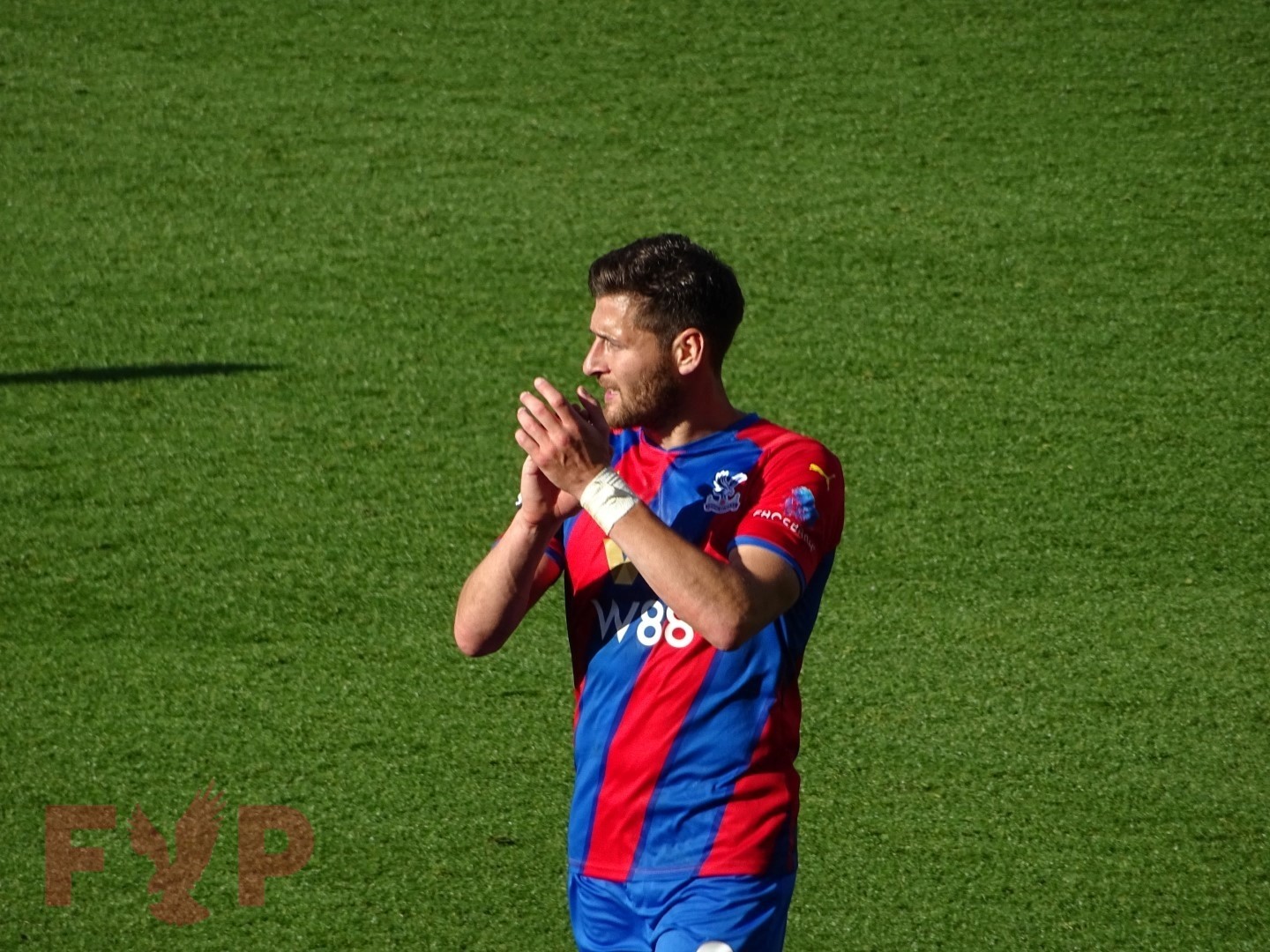
Ward Leicester Clap


Many people already know Joel Ward's journey to, and with, Crystal Palace in his near-decade at the club. Ward has persevered where others have left, despite various managerial changes. It's increasingly rare to have Testimonials in modern football, yet Ward will be the second player from the promotion team after Julian Speroni to have one.

On paper, the hiring of Patrick Vieira presented a wholesale change to how Ward has played in his career so far. Following the signing of a two-year contract extension in the summer, the challenge at hand was to prove he was more than a stopgap at the right-back spot.

In the second FiveYearPlan x TacticsNotAntics collaboration we will be looking at the numbers behind Ward's role change this season.


Sample Set


Our sample set includes the current season, along with 2017/18, 2019/20, and 2020/21. Since Aaron Wan-Bissaka had the starting job in the 2018-19 season, Ward only appeared for 552 minutes.


Right Back, New Role? 


Joel Ward is used to being the defensive player in a full-back pairing. He sat back when Dean Moxey pushed forward in the Championship, much as he did when Patrick van Aanholt overlapped in the Premier League. 

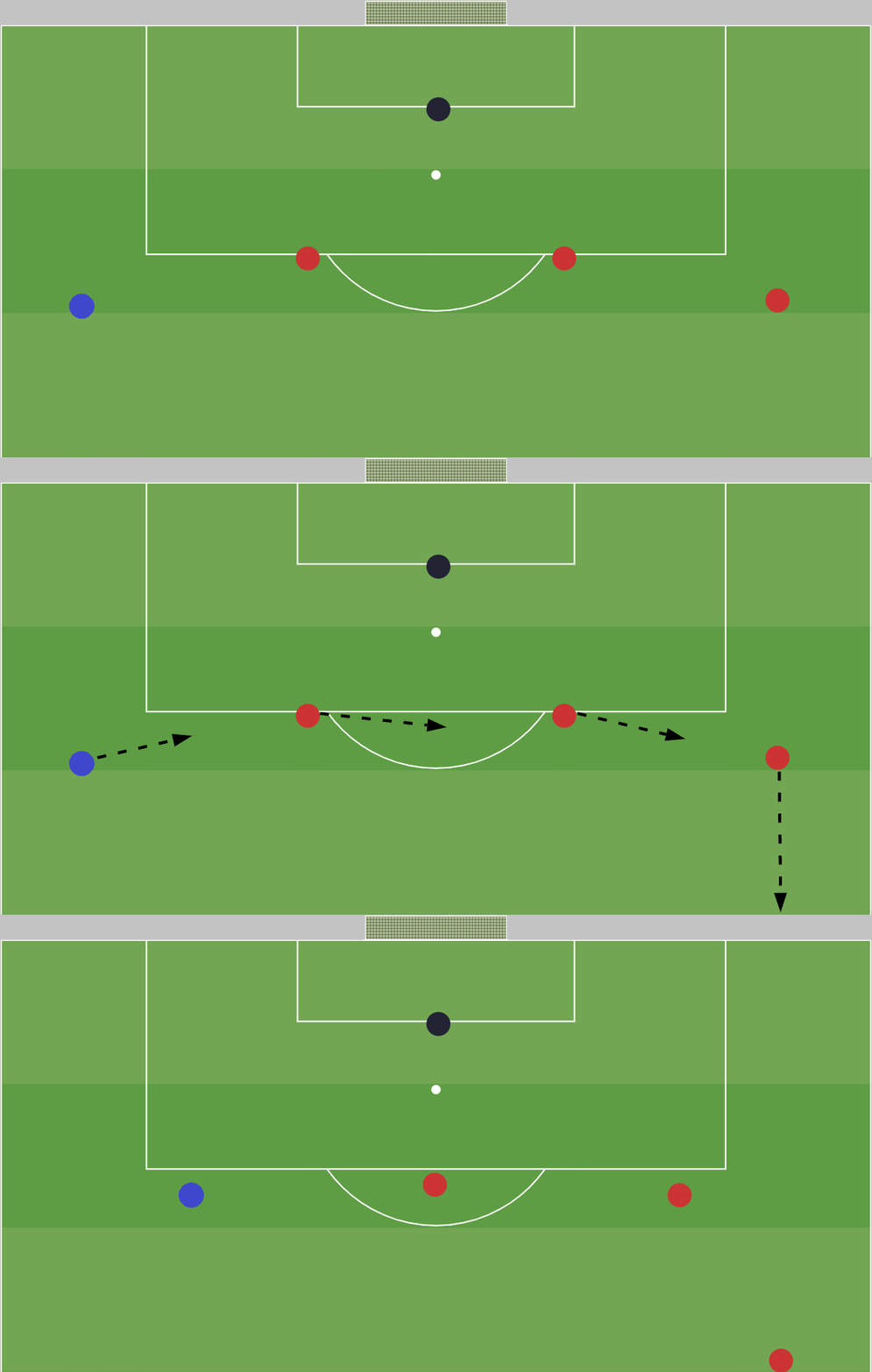
The reason it seems more pronounced this season is due to the change in playstyle. As Tyrick Mitchell pushes forward down the left, the remaining defenders rotate to make up a pseudo back three, with Ward and Guéhi almost mirroring each other on either side of Andersen. 


Backline


But where the counter-attack from van Aanholt was temporary, this backline not only looks to manoeuvre the ball repeatedly across the backline to find a way into midfield, they are doing this much higher up the pitch. 

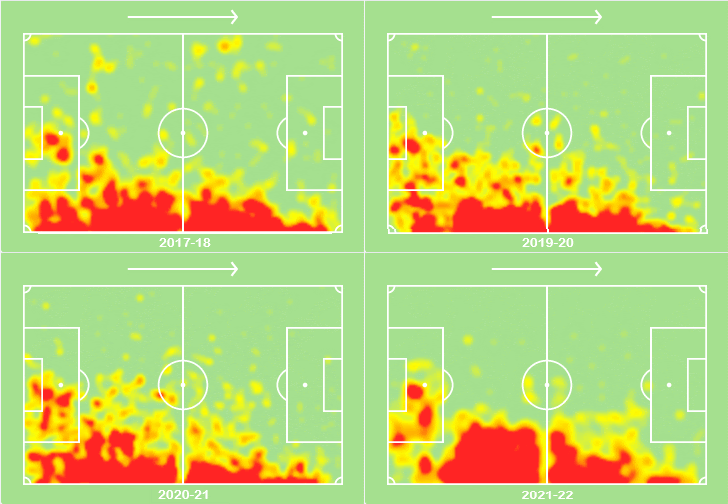
Ward's heatmap this season (courtesy of SofaScore), compared to previous ones, shows more touches towards the halfway line and in narrower locations. 


JW Heatmap


The strategy employed by Patrick Vieira - converting Joel Ward from a full-back out of possession to a centre-back in possession - is not new. Previously he used Malang Sarr (a central defender by trade, now at Chelsea) similarly at OGC Nice on occasion, only down the left side.  

In terms of size, Ward is already a "larger" full-back (188cm and 82kg), and probably could have been converted to centre back earlier in his career, so this change does suit his physical attributes. 

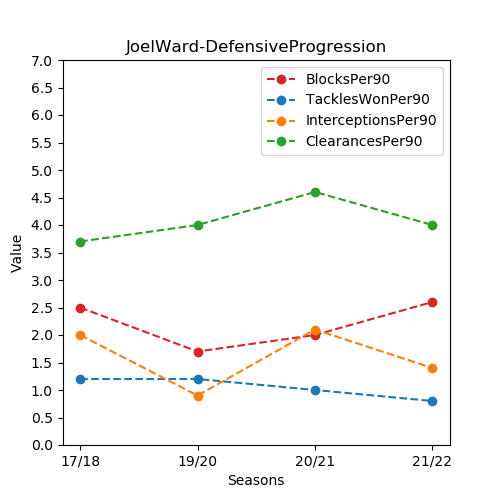
Regardless of how conservative the lineup in which he plays in is, he has remained relatively consistent in terms of statistics as a defender. There is some variation season-on-season, but the changes are not dramatic.

Ward Defensive Prog


Thus, considering his defensive consistency, the question mark over his game would be away from his defensive capabilities. Instead, he would respond to playing in a possession-oriented team that builds their attacks from the back.


Comfort in Possession


Of the starting back-four for Patrick Vieira, only one player was in place when he joined as manager. 

Dougie Freedman identified both central defenders to suit the new possession-based style, to join the club as "ready-made" ball-playing-defenders. Meanwhile, Tyrick Mitchell, as a younger player, wasn't married to a specific type of football. 

This left Joel Ward, yet to sign a contract extension, as the odd player out. A holdover of a different era of Crystal Palace football.

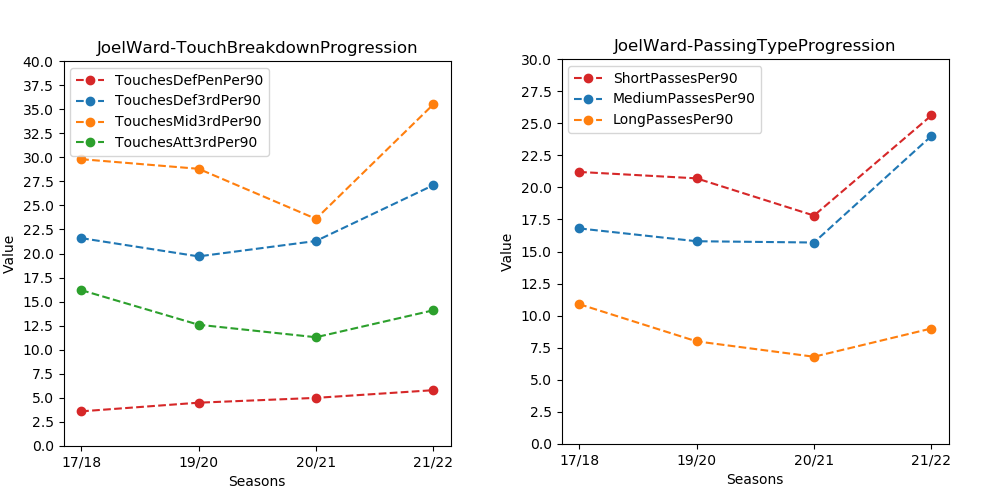
The changes in Ward's statistics have been stark. Patrick Vieira's system will require all the defenders to be on the ball more frequently and comfortable under pressure, and he has risen to the occasion.


Ward Touch Pass


Ward's touches per 90 min have increased from an average of 65 in his last full seasons to 83 during this campaign. As shown above, the changes aren't just about volume. The most significant increase has come in the middle 1/3 of the pitch, where the team can hold onto the ball with greater ease as the season progresses.

The volume of passes has risen quickly as well. The focus of Ward isn't to be the playmaker but help create angles for those around him, such as Joachim Andersen or Conor Gallagher. 

Consequently, if you look at the total distance of his passes, the percentage of those that go forward has decreased. In 2020-21, 49.3% of the distance of his passes was forward. Now, as he is looking to play the ball sideways or backwards, that has dropped to 32.4%.

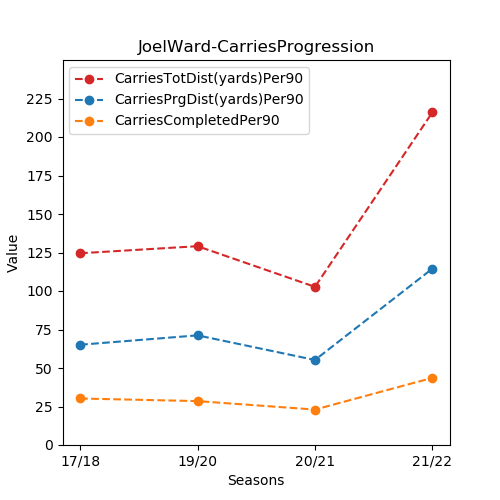
When given the space to move the ball forward, the defenders are asked to take it. In his short time with Crystal Palace, Marc Guéhi has already shown his prowess at driving past the first line of defence, and Ward has upped his volume again in this department opposite him.

Ward Carries Prog


In terms of total distance and "progressive" distance, Ward is on the ball far more. Under previous managers, you wouldn't expect to see him dribbling unless it was on an overlap, and even that appeared infrequent.

Joel Ward has gone on a quick learning curve in all of these aspects of possession football. It is still only eleven matches into the season, but given Patrick Vieira has already settled on a starting back-four, it has been a successful transition for him.


Crystal Palace 2-0 Wolverhampton Wanderers - Our Takeaways

Written by Alex Pewter

It was a strange afternoon at Selhurst Park. The victory wasn't surprising, which was surprising in itself. Patrick Vieira walked away with this second win on the bounce, and here are Alex Pewter's takeaways.


Gallagher Celebration 1


Second Half Fireworks


Either by design or with half-time adjustments, Patrick Vieira continues to see his team turn up the intensity as the second half starts. The first half seemed to be a muted affair, but Palace continued their streak of threatening more after the half-time break.

The novelty of seeing a Crystal Palace side in control of the ball and seemingly untroubled by the opposition hasn't worn off at all. Yet, a similar pattern is emerging of converting that first-half possession, 65% on this occasion, into meaningful shots on goal, as the team still only has one first-half goal this season.

The passing and movement to work the ball from one end of the pitch to the other is still a delight to watch, even if the final ball hasn't matched that standard. Marc Guéhi, on his way to his 82 passes for the match, was so comfortable at the back with or without the ball, it's still a wonder as to why Chelsea were happy to part ways.

The first half, whilst entertaining, seemed to drift by, with Rayan Aït-Nouri's attempts to buy a penalty in front of the Holmesdale arguably drawing the largest reaction from the home crowd in the first half.

Repeatedly Wolves players dramatically went to ground throughout the first half, possibly looking to stall play, adding to frustrations. 

But that was all quickly forgotten. 

With Wilfried Zaha and Odsonne Édouard now on opposite wings, both carried the ball superbly. Where Zaha looked hampered down the right, he was electric down the left. Suddenly with Zaha running at the Wolves defence, the crowd was alive in anticipation of a breakthrough. 

Édouard continues to surprise playing as a converted winger, and his run down the right would create the opening. Gallagher's pass set him free in acres of space, and the Wolves defence didn't deal with his cross. 

James McArthur picking up the second ball, ignored the cries of "shoot" from the crowd, as instead he calmly found Zaha with a clever through-ball to open the scoring capping off a spell of dominance. 

Embracing that this team plays off momentum, Vieira has continued to use his substitutes to sustain the attack. Using Jeffrey Schlupp and Michael Olise to drive home the result again, the team kept looking for a third goal as the end of the game drew near. 

Even if the team is leaving it to the final 45 minutes to close out games, it feels like the sky is the limit at the moment. 


Gallagher McArthur Wolves


Conor F'ing Gallagher


You should never fall in love with a loan player, as the old adage goes. But whether it was scoring the second or repeatedly chasing down José Sá in goal, Conor Gallagher makes it difficult not to love him and his performances. 

There is a danger that every match report becomes Gallagher centric, such is his form, but having taken a slight break in doing that after the Man City game, it is probably time to go over his skillset once again. 

Many managers have been guilty of forcing players to adapt to formations rather than building the system around the player. That isn't the case at Crystal Palace this season. In an asymmetrical system, he has the space to move further forward and get into the area in possession, and his athleticism is used to lead the press.

Conor Gallagher's drive defensively and offensively flourishes in a midfield where both the star player and a by-product of the players around him simultaneously. James McArthur is an egoless player and a perfect person to facilitate Gallagher's energy. 

Behind them both, Cheikhou Kouyaté feasted on the pressure the other midfielders maintained with a stellar defensive performance. 

His goal to double the scoreline had an element of good fortune with a deflection but spoke to the confidence in how he is playing. Indeed, it feels like he has the Midas touch in front of goal at the moment.

Thought must go out to John Textor if he had any aspirations to fund Gallagher's permanent move to Crystal Palace next season. The price may have just doubled.


Zaha Challenge Wolves


We Love VAR


It has been a long-standing position of FYP that VAR is the single most significant innovation in football since "On Me Shed Son" or the backpass rule. 

That opinion was vindicated today, as two video reviews overturned both the disallowed goal for Wilfried Zaha and a penalty given to Wolves that was an obvious error on the part of Graham Scott and in no way a marginal call that Joel Ward got away with.

The process is clunky. There is no transparency for the fans in the stadium. Yet, as the last three decisions have all gone Palace's way, let's forget all about that for now. 


The xG Battle

 
xG Wolves H 2021
 

There was only ever one team in this match. The attacking highlights did gloss over how few shots managed to get away, given the talents of Raúl and Hwang Hee-chan this season. 

Vicente Guaita kept his concentration levels up as he dealt with the one tricky effort, a low free-kick from João Moutinho.

Zaha and Gallagher took their goals well, but the damage could have been worse for Wolves.  

Édouard will be desperate to add to his tally, having got a couple of reasonable efforts on target today. His ratio this season of 3 goals to 1.97 xG is still an impressive return, but much like the Spurs game, he will be an excellent weapon when he gets it right.


Next Up: International Break III


On the one hand, it would be nice to carry on this form immediately into the next game, but instead, Palace will have time to plan their next run of fixtures. The November to January stretch of games is gruelling and will be a genuine test of the team's newfound depth.

One of the day's biggest stories, somewhat swallowed up by the Wolves win, was the 90 minutes of U23 game time for Ebere Eze. Not that Palace need much help at the moment, but he must almost be a certainty to be on the bench for the Burnley fixture.


Playing it Short - Vicente Guaita's Changing Role at Crystal Palace

Written by Alex Pewter & Mihai Patrascu

In the first collaboration between FYP and Tactics Not Antics, Alex Pewter and Mihai Patrascu take a look at how Vicente Guaita's responsibilities have changed since Patrick Vieira took charge. 

Guaita goal kick Liverpool


As part of the style change that Patrick Vieira has implemented - working the ball out of the back - there has been a notable shift in Vicente Guaita's playing style, especially when considering goal-kicks and passing. Here we dissect the differences, to explain how his role has changed and how he has had to adjust. 


Launched Passes/Launched Goal Kicks
 

In a statistical sense, a launched goal kick/pass is a kick of 40+ yards. 

Think of a Sean Dyche team. By design, Nick Pope is asked to hit the ball long on almost all occasions, leading the league this season with 89.5% of his goal kicks travelling over 40 yards in length. 

Similarly, both in his last season at Getafe and under Roy Hodgson, Guaita was asked to kick long on most occasions. This style is a tactical choice, rather than it being a case of being right/wrong.

A launched pass works in the same fashion. Imagine a back pass to the keeper. Whereas a goalkeeper like Ederson will look to recycle the possession to an open defender immediately, a more conservative goalkeeper like Nick Pope is to send the ball back over the halfway line. 

Here is where we can see the comparison from the four seasons of Guaita at Crystal Palace: 

In real terms, that change has seen him drop an average of 86% launched goal kicks down over the first three seasons to an average of 55% in the opening ten games of this season. A similar pattern has emerged in his passing. 

Guaita Launched Progression


Under Patrick Vieira, Guaita has also reduced the distance of his kicks, both in a dead ball and open play situation. It's easiest to reclassify his role from being a pure "shot-stopper" to a "ball-playing-goalkeeper".

This season you see a significant difference in Guaita's average length of goal kicks and passes:

In open play, the reason behind the drop off in his passing length is that role changed to a ball-playing-goalkeeper. The team is more likely to use him to keep possession, like the old fashioned sweeper would, sitting deeper than the other central defenders.


Guaita pass gk progression


When a defender is pressed, rather than clearing the ball as they may have before, the team can work the ball backwards to look for space elsewhere.


GK Pressure Pass


In this example above, Andersen is under pressure from the pressing forward and can play the ball back to Guaita, who, rather than looking down the pitch as the first option, finds Mitchell wide open for the easy pass that doesn't lose possession.


Guaita Attempted Passes


Consequently, the volume of short and medium passes has had a significant increase per 90 minutes, whilst increasing his overall accuracy. 

Guaita is set to complete ~330 more passes at all lengths this season compared to the last. In turn, he's becoming a much larger part of the team in possession.


Tactical Reasoning
 

What is the advantage of kicking short? At least in the mind of this manager? 

The team has invested in the two starting central defenders with purpose, partially because of the rule change that allows players to start from inside the box on a goal kick.

Having multiple short options means the opposition either a) allows Guaita to pass short on every occasion to his defenders or a midfielder, or b) they have to push up to prevent this.


Guaita Pass Options


Christian Benteke remains an excellent weapon for long goal kicks, and dragging more players towards Palace's area removes players around the target man and creates gaps in midfield.

Guaita's short passes to either central defender may even end up with a long-pass on many occasions, just from a different player. If Andersen receives the ball only a few yards away, as the forwards close him down, he may get a better angle to hit long or pass into the central midfielders or to a full-back.

Ultimately this approach is about getting the ball to playmakers in a more controlled and repeatable way, as well as providing different options depending on the opponent. 

While this role change may have posed a considerable challenge for the 35-year old Vicente Guaita at the beginning of the season, he has adapted quite well to its requirements. This in itself is reassuring, as his performances will be the benchmark of what Patrick Vieira will want from his goalkeeper(s) going forward. 


10 Games In - Crystal Palace's Point Trajectory

Written by Alex Pewter & Greg Waller

Patrick Vieira and Crystal Palace have reached the ten-game mark for the 2020-21 season. As a quarter of the season is already out of the way, it is an ideal time to look at the team's performance.

Gallagher ManCity


Beating the Forecasters


The pre-season odds were forecasting doom and gloom for Crystal Palace this season. It was a possible overreaction to several players departing, who were often injured, and a "rookie" manager, at least in the Premier League sense. 

Similarly, many analytics companies who set out their estimations for each match provides a neutral standpoint for how Palace are expected to perform.

The alternative is to make a consensus fan prediction, which is more likely to have bias involved. 

Taking FiveThirtyEight's model in this example is based on a detailed set of metrics to give a percentage chance for a win, loss or draw in every match. For those brave enough to read their explanation, find out more here. But needless to say, it is a thorough process.

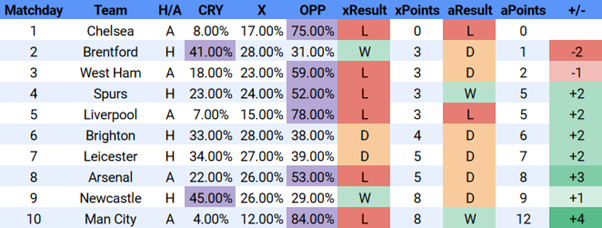
Taking these percentages, we can see how FiveThirtyEight saw Palace's chances in each match. If FiveThirtyEight's estimates give a clear favourite in the game, a win/loss is assigned, where there's no clear favourite, a draw.


xG1


Against these estimates, Palace has outperformed where FiveThirtyEight had predicted +4 on points. As expected, the only two projected wins were against Brentford and Newcastle, with draws against Leicester and Brighton.

It'll be interesting to see how these predictions update as the season continues.

The Trajectory

For any team outside of the Champions League mix, there are three clear targets for the season: safety from relegation, competing for a top-half finish, and an outside shot at European football.

Looking at every season from 2000/01 to 2020/21 helps paint a picture of the average point tally needed to achieve those goals.

  • For safety from relegation, we took 17th place +1 point.
  • For a top-half finish, we took 10th place +1 point.
  • For European contention, we took 6th place +1 point.

The average of those seasons gives us 39 points for safety, 50 points for a top-half finish, and 63 points to contend for Europe.

Next comes the projections:


xG2


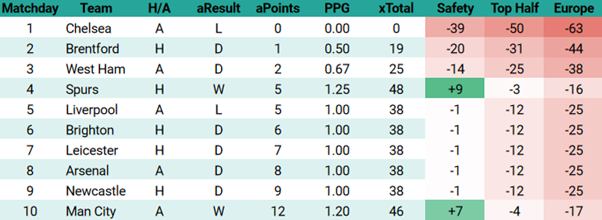
As each game progresses, taking the average point-per-game gives a loose idea of the team's trajectory. While the loss to Chelsea set off alarm bells, and the win over Tottenham arguably gave too many fans too much early optimism, it's easier to judge where the team finds themselves now that Palace has reached ten games.

Multiplying that out is an oversimplification, but it gives an idea of how the team will need to perform to reach their goals over the rest of the season.

The win over Man City made up for the points dropped against Newcastle and Brighton and puts the team ahead of where they need to be for safety after ten matches.

At the bare minimum, this is the pace the team will need to maintain to ensure safety in the first year of the rebuilding project, but the top half is well within grasp.


Strength of the Opposition


It is worth considering just how difficult these opening fixtures looked on paper. Palace has navigated it with relative ease, consistency, and with entertaining performances, which is very encouraging.

When the fixture list was announced in June, especially when paired with all of the uncertainty at the club at the time, the first three months of games looked very tough.

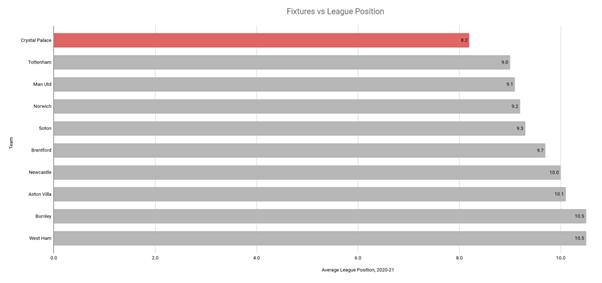
Taking a look at the league finishes from the previous season, this was with good reason.


xG3


As it stands, Palace has had the most challenging run of fixtures over the first ten games, based on the year before. Considering that Brighton and Brentford have vastly outperformed their respective ranking from last season, this only added to the potential difficulty level.

What bodes well from the first ten results for Patrick Vieria is that the schedule of games should be "softer" than they have faced to date for the remaining nine games until the midpoint of the season and that the team is already ahead of where many expected.

Turning the domination of possession into dominant wins is the next step.


Expected Points

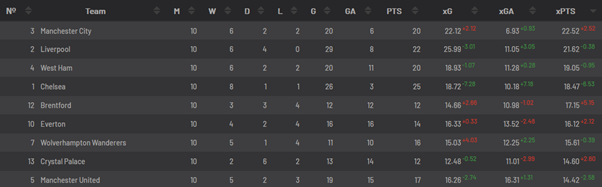
Using Understat's xPts (Expected Points) metric helps highlight that the current tally of points hasn't been a lucky process but hard-earned.

Based on the quality of chances throughout each game and assigning an expected point split for each team, Palace has underperformed in their results.

That isn't surprising when you consider the domination against both Newcastle and Brighton, despite failing to win.


xG4


Based on the performances so far, Understat projects that the team's performances have been worth 14.60 xPts. This would place the team in the 7th spot, six above their current position.

Games aren't won on xG alone, as last season's Brighton will tell anyone, but it's another reason to be optimistic.

The next check in will be after 20 games to see how the team has progressed.


Patrick Vieira Faces Selection Headache as Eberechi Eze Returns to Fitness

Written by Alexander Smith

Ebere Eze features for the Crystal Palace U23 side today. Here’s Alexander Smith with a look at how he might fit into the Palace first team in the coming weeks and months.

Eze 01


Following what has been a superhuman recovery, Ebere Eze is back. Well regarded by coaches and adored by fans at Palace after his fantastic debut season last year, his return presents a selection headache for Patrick Vieira.

It is perhaps not a question of whether he will play, but instead one of where he will play, and how his talent will be utilised in this new-look Palace team.

A lot has changed tactically since Eze last played for Palace under Roy Hodgson at the back end of last season.

A more dynamic, attacking side under Vieira, he will be excited to get playing. The style of football is likely to offer him more chances on goal, and more opportunities to attack with the ball at his feet.

Eze’s strengths are his dribbling skills and ability to drive through the lines at defenders, picking the ball up from deep. He also has a superb passing range with fantastic vision, so it is important he is played in a system that suits these strengths.

One issue for Vieira to work out is how to fit Eze into a side alongside Wilfried Zaha, Connor Gallagher, Odsonne Edouard and Michael Olise.

Such is the attacking strength of Palace this season, this is a massive (and very welcome) selection headache, with other players including Jordan Ayew, Jeffrey Schlupp and James McArthur also in and around the first team.

There are a number of options of how he could fit into this team. Here, I present some different options that we could see Eze deployed as, and how each would work.


Formation Option 1 - Attacking 4-3-3


Eze Lineup1


A first, more attacking option would be as a part of an attacking midfield three, in Vieira’s preferred 4-3-3.

This would best be used with a strong defensive midfielder, like Luka Milivojevic, to allow the two attacking midfielders to play with more freedom.

When used against a team lower down the league, with more defensive instability, this could be lethal.

Paired with either Connor Gallagher or James McArthur, both of whom are tenacious players on and off the ball, Eze would be able to collect the ball from deep, either off the centre backs or the holding midfielder, and drive at the defence, running through the lines.

This system would allow Zaha, Olise, Edouard and Gallagher to also play. Olise and Zaha would provide options out wide, dragging defenders with them.

The threats of Gallagher and Edouard through the middle would then occupy further defenders.

This would allow Eze to take on players, and there will likely be another option that is free. Eze has the ability to pick these passes, potentially unlocking the defence.

At the same time, playing with Gallagher would allow both to operate as playmakers, with one taking the ball on, and the other making runs and providing options. If nothing is on, then one can drop deep to survey the state of the game and restart attacks.

Gallagher’s energy alongside Eze would work well and would add an extra dimension to Palace’s attack.

Whilst they would need to be careful when losing the ball, the idea would be that the holding midfielder, Milivojevic in the example below, would be able to break up any counter-attacks as they begin.

Alongside McArthur in this system would put more emphasis on Eze’s creativity, but again, McArthur’s energy and tenacity beside him could really complement Eze’s style of play.

In this formation, too, chaos could be caused when one of the centre backs makes a surging run from defence, like we have seen already this season. This could create mismatches with an overload in attack, creating chances. Again, though, care must be taken to not be caught out on the counterattack.

This, in my opinion, is the system that would suit our attacking options best. But, against the bigger sides, where more pragmatism is required, this system would leave us open. So, there are some other, more pragmatic options to bring Eze into the side.


Formation Option 2 - Defensive 4-3-3


Eze Lineup2


A second option would be another variation on Vieira’s 4-3-3. This would see Eze play at the head of a midfield three, in front of two more defensively minded midfielders.

This would allow more pragmatism and solidity but would still allow Eze to play the playmaker role, picking the ball up from the holding midfielders and starting attacks.

From what we have seen this season so far, Vieira is not one to shut up shop, so this is by no means a fully defensive approach. Rather, it is a slightly more defensively minded version of the formation and tactics we know Vieira prefers.

This would allow Zaha, Olise and Edouard to play, but against a bigger team we might see Zaha in a front trio alongside Benteke and one of Olise or Ayew, making a slightly more defensively sound line-up.

However, this would need Gallagher to drop out the side, replaced by a holding midfielder, like Jairo Riedewald or Will Hughes to pair Milivojevic. A deeper James McArthur, or Jeff Schlupp could also work here, for a slightly more blended approach.

This would also provide a good option off the bench, with Gallagher’s energy replacing Eze, or vice versa if Gallagher had started. Likewise, this could shift into the more attacking 4-3-3, with whichever started on the bench coming on for one of the defensive midfielders.


Formation Option 3 - A Creative 4-2-3-1


Eze Lineup3


Another option would be as a number 10 in a 4-2-3-1.

This would be similar to the defensive 4-3-3, with Eze playing ahead of two defensive midfielders. The difference here would be that the three attacking midfielders may be more fluid, allowing them to swap positions between the three.

The wingers would start in a slightly deeper role, with a target man -- likely to be Benteke -- leading the line.

Whilst Vieira has liked using the 4-3-3, this could provide a bit more nuance to the attack, allowing Eze to drift wider, interchanging with the other wide players.

This would likely work well when Palace are on the back foot in games, with a focus on counterattacking. If Palace had started in a 4-3-3, then Palace could shift into this formation, especially when experiencing a period of pressure.

Also, Eze would be used to this formation, and type of system, having played as a number 10 at QPR in a 4-2-3-1, before joining Palace.


Formation Option 4 - Played wide in a 4-3-3 or 4-3-2-1 


Finally, Eze could start in a wide position either in the 4-2-3-1, or in the 4-3-3. This was largely how he was deployed last season under Hodgson, proving that he can pay out wide at Premier League level.

This would be a final option as whilst Eze showed that he was more than capable of playing out wide, this would be as cover if there are any injuries.

With Zaha starting so well on the wing, Ayew being ever dependable as an option, and Olise coming into the side, Palace have more than enough strength in the wide positions for Eze to need to be played out wide.

Vieira has also shown willingness to play Odsonne Edouard on the wing too, if needed, and Eze may only play on the wing should there be injuries.

Eze will see his best position as through the middle, and this will be where he can have the most influence on games. As such, being pushed out wide would more be a last resort, in my opinion.

It is very exciting for Palace fans to see Eze back in contention to be picked by Vieira. The football Palace are playing now is definitely a system within which he can thrive, and it will be interesting to see how Vieira utilises his talent.

Due to the nature of his injury, we will likely see him off the bench for the first few games before he is in contention to start. This will give us a good indication of how Vieira sees his game, and how he will deploy him.

It is important he is not rushed back in, and care must be taken to ensure he is eased back into the pace and physicality of the Premier League.

Wherever, and whenever he plays, Palace fans will be thrilled to see him back. He has spoken of his excitement of playing in front of the fans for the first time in red and blue, so he is sure to get a massive reception when he first comes on.

Let’s hope that Eze’s speedy recovery is completed this weekend, in front of the Selhurst faithful.